|
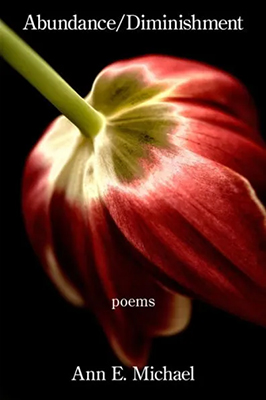
Abundance/Diminishment: Poems
by Ann E. Michael
Paperback ~ 57 poems ~110 pages
Price: $23.00
Publisher: Kelsay Books
ISBN #: 978-1-63980-521-1
To Order: kelsaybooks.com
Available also through Barnes & Noble
Reviewed by Michael Escoubas
Ann Michael’s newest book juxtaposes two seemingly opposite concepts: abundance on one hand, diminishment on the other. Without offering precise definitions, Michael achieves something far better. She paints word-pictures that breathe life into these venerable ab-stractions.
“Gardner’s Handbook,” serves as prologue and offers a discreet controlling metaphor. Here’s an excerpt:
First, you must learn the attributes of weeds,
the ethics of the garden, that the
dandelion’s knurled bud and jagged leaf
are a rebuke and an abomination–
that the plunge and pry of hook and knife
were just arbiters, purging the taproot’s sins.
As the poem develops, Michael synthesizes her theme that life itself is a study in abundance and diminishment. There is tension in play. Call it a form of spiritual tension, or light versus darkness. These lines in the same poem push the issue a little deeper:
That you must slide the hand hoe gently.
Slender wand-like sprays of crocus
must be left intact; you must finesse loose
shoots of furzy, pale-green thistle from between
emerging peony stalks furled and maroon
in the flowerbed. And learn
the matted ways of white clover when it spreads
plague-like amid the lily leaves.
These forces share a relationship. As participants in our universal life-experiment, Michael’s wise counsel to “slide the hand hoe gently,” is a perfect metaphor. In case you haven’t guessed, the poet is drawing her initial ideas from the Gospels. Matthew’s account of the Parable of the Tares (Chapter 13) reveals that good and bad, light and dark, weeds and wheat, abundance and diminishment, are both nourished by the same soil.
Each of Michael’s four divisions bears its own unique relation to the whole:
“Evolutions” contributes contrasts and analogies. For example, “Toad Night,” reveals that all things, even primeval things, like toads, have their rightful place in the scheme of things. Don’t be in such a hurry as to not appreciate them.
Did I mention that reading Michael offers an education in natural biology? I feel as if the poet is tutoring me in all things Natural. For example, “The Cockroach,” gave me more info on that dirty creature than I wanted to know! (In a mere ten lines.) Now that I know, I shall never view cockroaches in the same light. Michael has a way of conveying love for all creatures, plants, animals, and fauna. If it is alive, it has value.
In the next section, “What We’re Given,” I see patterns that support and reinforce Michael’s premise. “Markings,” is about ocean tides and patterns of life printed on the sand. In things most people are apt to miss, Michael sees as abundance and diminishment: gulls’ footprints, no pattern to discern, but human footprints are different–she brings her ill father into the poem. The markings of his walker in the sand become a pattern of sorts–signs of her ministry of compassion for him. In the same poem, Michael turns unexpectedly to explorers in Tanzania who find “familiar patterns that “mark our [humanity’s] paths to and from the sea. Other poems of note are “Late May,” “Damage Zones,” and “Apology.”
Section 3, “Semaphores” sends life-signals. For example, “Beginning to Cast Off Unnecessary Things,” signals it is time to take a deep dive into what truly matters in life:
Our bodies look strange and pale, awkward serpents in
a foreign sea; in our nakedness we are unfamiliar even
to ourselves. We shiver under birch trees whose white
skins burst and peel. You say it is time to go home.
Michael’s conclusion hit me hard. I, too, own extra baggage. This is about more than cleaning out the attic! Look for more “semaphores” in this section; finding them may challenge your thinking, as it did mine.
By the time I opened the last section, “Whatever You’ve Lost is With You,” Michael has come full circle. As with the parable, which avers, that weeds and wheat coexist (always have, always will), I felt a sense of completeness. I felt as if the poet knew me, that she and I shared the human dilemma. I return to where I began, Michael’s closure from “Gardner’s handbook”:
“… Take up your wire claw and trowel.
Tuck your ethics into your leather belt,
go forth into the wilderness and into Eden
understanding both the plantain and the bluebell.”
Ann Michael’s Abundance/Diminishment, unique, original … full of surprises: a five-star collection.
|


