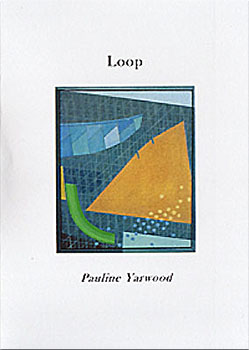
Loop
by Pauline Yarwood
21 poems, 30 pages
Price: £5
ISBN: 978 -838337803
Publisher: Wayleave Press
To order: https://www.wayleavepress.co.uk/
Reviewed by Neil Leadbeater
Pauline Yarwood is a poet and potter living in Cumbria, North West England. Her poems have appeared in The North, The Interpreter’s House and Fire Crane. In 2013 she was mentored by Judy Brown at the Wordsworth Trust, and in the same year collaborated with the artist Kate Bentley to write a series of poems for the catalogue of her exhibition, Skyline. She is a member of Brewery Poets and has read as guest poet at the Brewery Arts Centre, for A Poem and a Pint, April Poets, Settle Sessions and for the Wordsworth Trust at Zeffirellis, Ambleside’s award-winning food and music venue. In June 2016, with Kim Moore, she co-directed the first Kendal Poetry Festival which they are now planning to hold as an annual event.
Following on from her previous collection, ‘Image Junkie’ (also published by Wayleave Press), ‘Loop’ begins from a specific locality as the poet leads us through a gate as if we are stepping over the threshold into her poetic world. We are not told what type of gate this is. It could be a swing gate, a five-bar gate, a double leaf gate or even a kissing gate. All we know is that it is made of metal and that it leads into a valley. The sound it makes when it closes echoes round the valley and is pleasing to the ear. There are suggestions in the title, ‘loop’, that this may be a circular walk. Frequent repetition of the phrase ‘this is the gate I walk through’ together with other repeated lines serves to keep our focus on the gate and the idea of actions going round in circles. The poem’s title is redolent with meaning. In electronic music, for example, tape loops, that is, loops of magnetic tape, are used to create repetitive, rhythmical musical patterns when played on a tape recorder. If we look to the title of this collection, which is also the word ‘loop’, there is an affinity to be found with the three poems about sailing: ‘Inlet’, ‘Storm’ and ‘At Sea’ when we think of ‘The Great Loop’ that recreational mariners or ‘loopers’ sometimes take in and around North America. The cover image, ‘Blueprint for the voyage home’ by Mike Barlow, is the perfect fit for this pamphlet.
‘At Sea’, is an incredible tour de force of writing. Without any sense of build-up, a sudden storm takes us by surprise. The poem opens with the line ‘Confusion, ropes tangled, sails in shreds.’ Every line of this poem depicts in vivid imagery a vessel in turmoil. The fast-paced lines, full of detail, hardly leave us time to breathe. Here is the second stanza:
The compass needle skittered and scudded
and we were thrown, directionless,
on the cabin floor, scrambling to find
the right chart, all spilled into the blue-purple glaze
of petrol that had oozed from the engine.
The storm passes as suddenly as it came. ‘A maelstrom? A whirlpool? No ordinary squall. / Hell-bent. The only way to explain our helplessness, / the permission we gave each other to be utterly afraid.’
Another sequence of poems, this time on the subject of hill-walking and mountaineering, takes us to the Rum Cuillin traverse and remote Scottish islands such as North Rona and Ulva as well as fells in the Lake District, closer to home. At one of these fells Yarwood describes the phenomenon known as the ‘brocken spectre’. According to the Met Office, this effect is produced when a person stands above the upper surface of a cloud, on a misty mountain or high ground, with the sun behind them. When they see their shadow, the light is reflected back in such a way that a circular ‘aura’ appears around the point directly opposite the sun:
….as we turned / to check the wind, the sun broke low behind us / and cast our shadow across the valley / on to the falling mist, the diffracted light / bent into a halo. We raised our arms, / moving two steps to the right, two to the left / and appeared to be greeting ourselves.’
Yarwood’s love of expressive language comes to the fore in ‘Tell it like it is’ where she explores a few neologisms and expresses her appreciation of German with words such as weltschmerz – which she translates as ‘a melancholy, world weariness’- and the delightful die backpfeifengesichter – ‘faces in need of a slap.’
Stylistically, Yarwood is equally at home with page-length poems as she is with poems that are only a few lines long. Some of her poems contain unusually long lines and others are very brief. Both styles fit the subject matter perfectly. Here is the full text of one of her shorter poems, ‘Curlew’:
Your heart
lifts at the first
high sound of curlew notes
but from the roof it’s a starling’s
half-riff
The unmistakeable, haunting call of the curlew can often be heard in isolated places such as heathland and moorland, open places that Yarwood frequently writes about in this collection.
Poems such as ‘Depth of field’ and ‘Secession’ show real originality. The powerful, sometimes unexpected end-line in poems such as ‘Walking the bridle path’ and ‘Hazel whips’ adds so much to what has gone before. The unexpected violence encountered in ‘No escape’ highlights the fragility of our world and our own vulnerability in it. This is a collection that is bursting with energy and leaves us with a real zest for life. |


