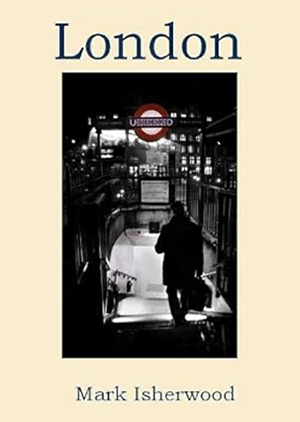
London
by Mark Isherwood
2 poems, 52 pages
Price:£9.95
ISBN: 978-1-909404427
Publisher: Poetry Space Ltd
To order: www.poetryspace.co.uk
Reviewed by Neil Leadbeater
Mark Isherwood writes both poetry and fiction. His first collection of poetry, Lethe, was published by Anaphora Press in 2011 and his first novel for children, The Thief, The Witch and The Shop of Curiosities, was published in October 2019. Originally from Dorset, England, Mark now lives in London with his wife and their three sons.
London comprises one long poem divided into thirty-nine sections and one shorter poem. Both read well as performance poetry but they also sit well on the printed page. They can be read as separate entities or as a sequence of poems which in turn may be read in any order being somewhat interchangeable without detriment to the overall effect.
The long poem is a painting in words: brushstrokes on a broad canvas which convey to the reader the hustle and bustle of city life at different times of the day and night. Each section focusses on a specific subject: football, suburbia, the city skyline, the rush hour, graffiti, the homeless, transport, the concept of home as an urban refuge and migrants in the city. None of the sections have titles, few have punctuation and most are written in an abbreviated style, ‘an Oxford street pedestrian cavalcade’ that delivers up ever-changing scenes in a fast-moving set of observations. Isherwood is a man in a hurry who does not stop to dwell on images or wax lyrically on extended metaphor.
Several sections in this poem caught my attention:
In xvi Isherwood captures the way in which areas of London can suddenly change without warning, in particular, the way in which an affluent area can rub shoulders with a rundown area providing a sharp contrast between the two:
It’s a broken road that leads to nothing street
back alleys, dead ends and barren closes
run strangely parallel to prosperity boulevard
East End to Docklands
New Bond Street and Peckham Rye
Ascot days and unlicensed club nights
Harrods and the hard up
school fees and free school peas…
Some tongue-in-cheek alliteration opens xviii:
Lewisham, lovely, lyrical and languid
Peckham, poignant, peaceful and parnassian
Hampstead, horrid, hideous and hellish
Richmond, ridiculous, rancid and riotous…
I say ‘tongue-in-cheek’ because not everyone would describe these London suburbs in such a manner. Speaking as someone who once lived in London for a time, Hampstead to my mind is peaceful and parnassian and Richmond (which technically speaking is in Surrey) is lovely lyrical and languid…but then the reader is told at the start of this volume that ‘this is my London / not yours / but you may find things we share’.
In xxiv, Isherwood likens the onslaught of morning commuters at Victoria underground station to a turbulent waterfall that gathers force as it nears the ground:
Victoria concourse to the tube
morning, the great work magnet
waterfall down the stairs
white water turbulence
rough and random
deep pools
people sieve through barriers
drain to the tunnels
fluid human dynamic
In xxv which is written as an ‘epitaph to the London chimney’ we are taken from the present, (‘at least a hundred million roof top dead / their littered corpses ornate or ugly / cold crumbling never again fires fed’) where there is now no longer any need for chimneys, back into the smoke-filled, polluted past:
smoggy night in fifty two
through street, under door and open window
a cyanide pea souper
thousands died
and now
chimney markers
A similar contrast, this time one that works in reverse order to the last one by going from the past to the present is presented in xxvi where steeples and spires, naves and aisles give way to ‘temple tops, domes, minarets / mobile towers, wheels, blocks / clocks, shards, gherkins…[a] City in search’.
Two poems arise out of well-known lines penned by other poets: Marlowe’s ‘Come live with me and be my love’ (Donne used the same line some time after Marlowe, too) and Keats’ ‘Season of mists and mellow fruitfulness’. In both cases, Isherwood takes a step back from the free verse forms in his other poems to utilise rhyme as a kind of concession to the past.
***
In the year leading up to the outbreak of the First World War, Ralph Vaughan Williams composed his second symphony. Rather than designate it a number, the composer preferred to call it ‘A London Symphony’ since it was written in celebration of his adopted city. Even though it was intended to be heard as absolute music, its soundscape suggests a programmatic piece, so much so, that Vaughan Williams gave his consent to the conductor Albert Coates to provide elaborate descriptions for its 1920 performance. During the course of its four movements we hear the Westminster chimes, an evocation of Hampstead Heath on an August Bank Holiday, Bloomsbury Square on a November afternoon and the Westminster Embankment at night. The last movement is an evocation of the old order passing away while the Thames flows on.
In the final poem in this volume, ‘Vaughan Williams No 2’, Isherwood follows the score and its programme in close detail, casting the poem into four movements which mirror those of the musical composition. Here, for example, is the second part of the poem:
lento
muted strings
lonely voices
Bloomsbury square afternoon, november
cold bare trees and benches
overcoats grey
calm
cor anglais, flute
trumpet and viola
a moment forte
then rising with the cold sun
autumn again
These carefully observed poems give us a portrait of a complex and ever-changing metropolis glimpsed through the eyes of a stranger ‘wearing an ill-fitting skin’ who is having to come to terms with city living. |


