|
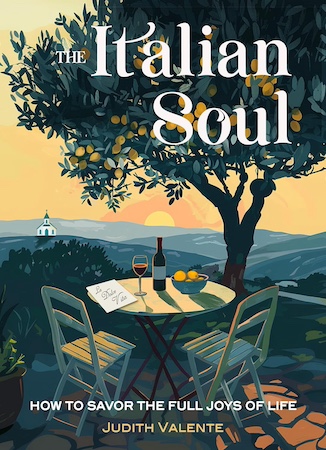
The Italian Soul
How to Savor the Full Joys of Life
by Judith Valente
Format: 5 x 7 ~ Perfect Bound
20 Reflections ~ 20 Illustrations ~192 pages
Price: $16.95
Publisher: Hampton Roads Publishing
ISBN: 9781642970722
Available Now To Pre-Order: Amazon or Barnes&Noble
or BookShop or BAM
And after May 1, at RWW:
ABOUT THE BOOK:
The Italian Soul is a pilgrimage of the heart, a journey toward change that will allow its readers to approach life with a more contemplative stance and recreate a sense of la dolce vita–the sweet life–wherever they might be.
ADVANCE PRAISE:
Judith Valente masterfully captures the essence of the Italian way of life, especially the slow, purposeful rhythms of its small towns. In contrast to the chaotic fast life of urban metropolises, this book offers a regenerative antidote: a deep dive into the values of connection, quality, and the beauty of local traditions. The Italian Soul is a heartfelt guide for those yearning to embrace a more mindful and fulfilling way of living.
–Rita Salvatore, President of Slow Food Abruzzo, Professor University of Teramo and the American University in Rome
The Italian Soul speaks to the growing yearning that I see among so many to live more joyfully and mindfully amid the demands and distractions of daily life and the growing tumult of the world. Judith Valente offers sound wisdom and practical guidance from her many stays in Italy and lessons learned from a people (my own!) who have made an art of living fully. Whenever I visit Italy, I wonder: What is their secret? This is a book for spiritual seekers and all who want to bring a piece of the Italian way of life into their own homes.
–James Martin, SJ, author of Learning To Pray: A Guide for Everyone; My Life with the Saints, and The Jesuit Guide to (Almost) Everything.
ABOUT THE AUTHOR:
Judith Valente has won numerous awards for her work as a former correspondent for PBS, two NPR stations, The Wall Street Journal, and as the author of several spirituality titles. Her most recent books include How To Live, The Art of Pausing, and How To Be. She has published two poetry collections and is a sought-after retreat guide who leads the annual Benedictine Footprints retreat/pilgrimage to lesser-known parts of Italy. She is also president of the International Thomas Merton Society.
FROM THE BOOK:
Prologue: Pursuing the Sweet Life
by Judith Valente
This is a book about love. My love as an Italian American for the home of my ancestors, a land that Dante called Il bel paese dove il “Si” suona. “The beautiful country where the ‘Yes’ resounds.” It represents the culmination of a quest. A quest to nurture in myself that same propensity for living fully that I find in my Italian friends–an attitude that looks out at the world with a sense of openness, attention, and wonder.
Whenever I am in Italy, my experiences seem more immediate and intense. I am by nature a hard-charging American, often afflicted with a dual diagnosis of workaholism and over-achieverism, always trying to fit more into my days and seemingly never having enough time. In Italy, I somehow have time enough for everything–work, play, family, friends, cooking, cleaning, walking, exercising, and, yes, simply doing nothing. Whenever I leave, it is with the haunting intimation that I can indeed reinvent my life in the States to be just as balanced and enchanting.
I depart Italy always with the same feeling: I found what I was looking for. I have experienced that feeling in only one other context–on visits to monastic communities. Because I write books that aim to help busy people like myself slow down and live more reflective lives, I’ve spent considerable time in monasteries–studying, praying, and seeking to learn from men and women who want to rise beyond the superficialities of daily life, who yearn to see what St. Bernard of Clairvaux called the real behind the real. In short, who seek a more contemplative life.
What do I mean by a “contemplative life”? It is an attitude of the heart that allows us to see in the simple, mundane elements of daily living both the sacred and the poetic. It is a prescription for experiencing meaning and joy. Repeatedly, I witness that attitude in my Italian friends. It seems to come naturally to them, something passed on through the genes from one generation to the next.
This book is an attempt to distill those contemplative aspects of Italian life that we can absorb into our hard-driving American culture. What you will find in these pages are not complicated self-help prescriptions. Rather, these are love notes, dispatches from my many extended stays across Italy in both major cities and small towns–first as a student, later as a journalist, and most recently as a humble appreciator and observer of daily Italian life.
I write for lovers of Italy who have visited the country often and who will be able to compare notes from their experiences with mine. I write also for those considering a first visit, and for students of the Italian language and culture. I write especially for those seeking to deepen their interior life and follow a spiritual path that travels beyond institutional religion, but does not necessarily dismiss it. A path that does not depend solely on a particular doctrine, but recognizes that the sacred also abides in the simple practices and activities of daily life. Picture yourself walking beside me through narrow streets, peering through half-open windows, catching snippets of conversation and glimpses of the practices, customs, and traditions of a people who look upon living as an art.
There is much to admire about Italy: its remarkable history, storied art and architecture, superb food, classic wines, and elevated aesthetic sense, be it in fashion or product design. What I appreciate most is its gentler, more balanced way of life–what might be described in a kind of shorthand as la dolce vita, the sweet life. My Italian friends taught me to value the sanctity of the dinner table. I learned from them to prize quality over quantity, to recognize when enough is enough. They introduced me to the simple practice of building community through chiacchiera, the tradition of ad-hoc chitchat that goes on daily in cafés and grocery shops, on street corners, park benches, and even in doctors’ offices (a favored meeting place for sharing news and opinions). Italy taught me to pay attention to self-care as diligently as I care for my career. To pride myself on relationships as much as professional achievements.
I learned an important lesson about balancing priorities when a friend, who lives in the town of San Vito Chietino on the Adriatic coast, asked me to lunch one Sunday at her home. She invited her parents as well. Throughout Italy, the Sunday meal with family remains a sacrosanct tradition. I usually publish a column on Sundays on Medium.com and hadn’t finished writing it yet. I brought my laptop computer to the lunch, figuring I could finish my writing before the meal began. When I started typing at the coffee table, my friend’s mother looked at me quizzically. I explained to her that I needed to complete some work.
“It’s Sunday!” she exclaimed.
I shut down the computer and kept it out of view for the rest of the afternoon. The heart of the lesson came later that day. When lunch was over, we all went for a long, leisurely walk along the Adriatic seashore. I remember the walk vividly because I was so touched by how my thirty-six-year-old friend still strolled arm and arm with her parents, and how the sea air refreshed all of us after our delightful, multicourse meal. I finished writing my column later in the day, in plenty of time to publish it. I didn’t have to sacrifice time in the company of friends. I could enjoy a delicious meal, relax, take a stroll, and still get my work done. For all that, I have my friend’s wise Italian mother to thank.
One of my coauthors over the years has been Brother Paul Quenon, a Trappist monk of the famous Abbey of Gethsemani in Kentucky, where the great spirituality author Thomas Merton once lived. When I left my full-time job in broadcast journalism to focus on writing books, I lamented to Brother Paul that I couldn’t seem to arrive at a proper working rhythm. I felt I was flailing around, wasting too much of my day. He wrote back: “Indeed, a good way of getting over the feeling that you are wasting your time is to go out and waste more of it. Waste it intentionally. Take a walk in the neighborhood and see the trees; notice how people keep their yards. Smell the air. Get free of what seems urgent and necessary; get away from the feeling that the world will crumble without you.”
Brother Paul described a “free gift” he said he had received the previous evening. It was the sight of a full moon pouring a gauzy, mother-of-pearl white over the fields surrounding his abbey. “To see a sight like this is rare,” he wrote. “You must be there.” My friend’s Italian mother would wholeheartedly agree. Such pauses are moments of grace, what Italians might call il dolce far niente, the sweet do-nothing. They are also pathways to experiencing the sacred. They allow us to experience the blessings of life and creation through small cracks of wonder in our daily existence.
Italy also gave me a greater appreciation of a word that is integral to the monastic, contemplative life, but that we hear all too infrequently these days in our American public discourse. That word is community. As the US sinks more deeply into a pool of Me-ism–of them against us–our sense of the common good is in jeopardy of drowning as well. That became clear when so much rage erupted during the Covid-19 pandemic over vaccine and mask mandates. I traveled to Italy in 2021 just as the omicron variant had begun to surge in the US.
I took a shuttle bus to Chicago’s O’Hare International Airport at a time when face masks were still mandated on public transportation. The gentleman seated behind me had his mask pulled down under his chin. I waited to see if he eventually would pull it up and cover his face. When he didn’t, I politely reminded him of the announcement the driver had made about wearing our masks. He reacted by launching a stream of expletives at me. It caused such a ruckus that the driver threatened to stop the bus if this passenger didn’t calm down.
When I arrived in the small Italian town where I was to stay for three months, I noticed how everyone I saw adhered to the national mandate for masks in both indoor and outdoor public places. In churches, large green dots pasted onto the pews ensured socially distanced seating. Bottles of hand sanitizer were placed near the entrance. At communion time, before receiving the host in their hands, people would fish into their pockets or purses and pop open personal-sized bottles of sanitizer, then look around to offer their bottles to others. It was a small gesture of kindness, but a measure too of fostering community, of saying we are all in this together.
That same spirit was on broad display in other ways. Italy was one of the first countries struck by the coronavirus pandemic, and among the hardest hit. Italians didn’t show up at government buildings brandishing guns to protest stay-at-home orders and school and business closings, as some Americans did. Quarantined in narrow houses and cramped apartments, neighbors instead serenaded one another from their balconies, singing and playing musical instruments. To shore up everyone’s spirits, nurses broadcast the Italian national anthem over loudspeakers in hospital wards. Italians showed the rest of the world how to meet trauma and tragedy with beauty and grace.
The strong interior pull I feel for Italy originated with my four grandparents. As the youngest grandchild, I did not know much about three of those grandparents. My paternal grandfather, Tommaso Valente, died before I was born. My mother’s mother, Elvira Tedeschi Costanza, passed away when I was four. My father’s mother, Giovanna Mastronardi Valente, endured frequent hospitalizations, which meant I had few encounters with her before she died when I was thirteen. That grandmother became a cipher I puzzled over throughout my life. Interestingly, she became the ancestor most responsible for my rediscovering my Italian roots.
When I began studying monastic spirituality, I visited the famous Abbey of Monte Cassino about ninety miles south of Rome. St. Benedict, the founder of Western monasticism, lived his final years at Monte Cassino and it is where he wrote his famous Rule for monastic life. Monks and monastic sisters still follow that fifteen-hundred-year-old text today, as do an increasing number of laypeople like me, who seek to live the monastic values of community, consensus, hospitality, prayer, and praise in daily, secular life. Only afterward, in conversations with my older cousins, did I learn that my grandmother Giovanna had grown up in Cassino. She would have seen the Abbey of Monte Cassino every day of her life before emigrating to America, as the monastery dominates the city from its mountaintop perch. Suddenly the genesis of my fascination with monastic life became clear. It was as though I had been hardwired by my genes to develop a passion for contemplative living. My Italian heritage led me there.
The one grandparent I did know well was my maternal grandfather, Benedict Costanza. He lived to the age of ninety-five and spent part of each year with my aunt and uncle who lived on the second floor of my parents’ two-family home in Bayonne, New Jersey. Grandpa Costanza told me of his early life in the Sicilian seaside city of Messina and of his ocean voyage to America, which sounded to my five-year-old imagination like an adventure movie plot. He eventually sponsored his parents and all six of his siblings to come to America. The drawback for me was that virtually none of that side of the family remained in Italy. Nor did my grandfather or any of his siblings ever return to their native land. Still, our Italian roots never faded from view. They remained like an invisible magnet, connecting us to something beyond our middle-class American life.
I still have the black-and-white, marble-covered composition book in which my grandfather jotted down in his old-world-style handwriting Italian words for me to memorize: La madre. Il padre. La sorella. Il fratello. When he told of licking the salt from his skin after swimming as a boy in the waters off the coast of Messina, I could taste the sea salt as well. I finally had the chance to visit Italy for the first time on a class trip as a junior in high school. I felt more at home there than in the country where I had been born. From my grandparents, I carry within me the seed of a dual-layered identity. To this day, their example helps me combine the best of my Italian heritage with what I cherish in American culture. They gave me the gift of living with two cultures interwoven in a single soul.
There is a lovely Italian idiom, all’Italiana. It derives from the expression, alla maniera italiana: in the Italian manner. It is more than a style, though. It connotes a way of life. I hope these pages will help you to bridge our American culture with the attitudes, traditions, and practices that make Italian life a model for experiencing a sense of the sacred amid the many demands and distractions of ordinary living. Though this is not a travel book, it is a place for readers to travel along. Within these pages, it is possible to come and go, read and rest. Think of it as a platter, offering several diverse spiritual “recipes” for nourishing the soul.
The Irish poet and theologian John O’Donohue has written, “Always in a pilgrimage there is a change of mind and a change of heart.” May the time you spend as a pilgrim within these pages touch your heart in ways that bring a taste of the Italian dolce vita into your own home. I invite you to sit in your favorite reading chair and let your soul travel vicariously with me. Buon viaggio!
|


