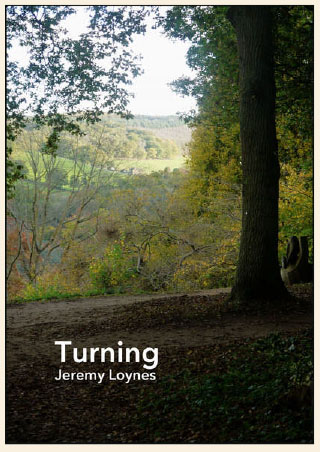
Turning
by Jeremy Loynes
32 poems, 41 pages
Price: £6
ISBN: 978-9-781907432
Publisher: Dempsey & Windle
To order: dempseyandwindle.co.uk
Reviewed by Neil Leadbeater
This collection is divided into two sections titled ‘Turning out’ and ‘Turning in’, what goes on outside us and within us. Each section contains sixteen poems and is the product of several years writing as an observer and admirer of the peaceful Surrey landscape in south east England. For those who do not know it, Surrey is bordered by Greater London to the north east, Kent to the east, East and West Sussex to the south, and Hampshire and Berkshire to the west. The North Downs, a chalk escarpment which runs from the south-west to the north-east and divides the densely populated north from the more rural south, is its defining geographical feature. Surrey is also noted for having the densest woodland cover in England. It is against this backdrop that the poems in this collection have been created by a poet who clearly shares Edward Thomas’s love of the English countryside, adopting the same kind of meditative, gentle approach to his subject matter.
In the opening poem, ‘Lost and found’ Loynes writes of his very fist encounter with nature and of the lasting impact that this has had on his life:
From the first day I went to the hills,
to the soaring sky, the high sheep tracks,
from the first day I went to the hills
I was lost
and never came back.
In ‘My creed’ he says:
Let no one henceforth know that I went there,
no footprint, no bended grass, no scuff or tear,
no ruffling of the treetops’ shaggy hair,
no breach, no rip in nature’s fabric anywhere,
no, nothing should remain to mark my passing there,
except, except the faintest stirring of the air.
Subjects covered in the first part of this collection include a poem on the life cycle of an apple, contrasts between urban and rural life, observations on the fresh green leaves of trees before the dust of summer begins to dull their sheen and a poem on a long, lingering winter that has gone well past its sell-by date. It is often the incidental things that inspire him, the things that most of us overlook to our detriment. ‘South Hams hymn’, for example, celebrates warm evening light that ‘cuts sideways / through the crooked lanes and fields, / flooding down the little shy-ways, / half-hidden paths, concealed.’ In ‘Everything in nature’, he celebrates things that do not even have a name such as ‘the freshness in the morning after rain’ and ‘the way the wind runs fingers through tall grasses’. Such things are real enough to those of us who have a practised eye to see them even though we cannot find the exact words to define them.
Throughout several of his poems there is this sense of time passing, of days never more to be regained, which makes every passing moment all the more precious to us. In ‘Teacher’, the last poem in the first part, Loynes personifies winter reminding us once again of the unstoppable turning of the seasons and the passage of time:
Winter is our teacher,
dark, austere and cruel.
And drunk on dreamy August days and stuffed with
summer’s fruits,
we are but summer’s fools.
The short lines in this poem make us stop in our tracks while the longer lines are given over to our indulgence.
In the second part of this collection, ‘Turning in’, which is more concerned with interior spaces, Loynes goes back in time in search of his childhood where he still finds ‘the tug of time and tide at play’. He contemplates the worth of a bean, asks ‘what makes us more than mere machines’ and concludes that ‘it is the inner life that makes us real.’ In ‘Meditation’ the final stanza reveals water as a purifying element:
Then I’ll look down through the water,
my still mind a perfect lens,
and shape my thoughts as the pebbles,
integral, ordered,
cleansed.
Stylistically, Loynes pays attention to form and makes use, unusually these days, of rhyme.
The front cover is of a scene taken at Winkworth Arboretum, South West Surrey, photographed by the author.
Loynes is a poet who reveres the natural world and has no desire to distort it. He seeks clarity and lucidity and, in so doing, captures the very essence of things.
|


