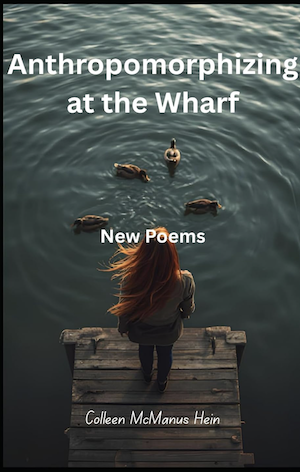
Anthropomorphizing at the Wharf: New Poems
by Colleen McManus Hein
50 Poems ~ 80 pages
Price: $4.60 ~ Kindle: $.99
Publisher: Independently Published
ISBN-13: 979-8277552179
To Order: Amazon.com
Reviewed by Michael Escoubas
Of the more than 250 poetry collections I have reviewed, Colleen Hein’s latest project has the distinction of: Most Interesting Title! To anthropomorphize is to attribute human characteristics to nonhuman subjects. Hein’s fascinating cover art sets the mind spinning as she dwells at pier’s end contemplating a world populated by ducks swirling, paddling, dipping and living in their world.
Poet Colleen MacManus Hein shows a heightened facility for bringing her imaginative world up front and personal in a way we “average” readers can see ourselves in the mirror of everyday life. This quality is evidenced in these excerpts from her title poem:
The ducks came because we laughed,
Paddling at us from both
Ends of the harbor like
Tugboats to a beacon.
My husband said later
They were just hoping for crusts–
And people mean crusts–
But I knew
They were showing off,
Wanted us to see the way they could
Stand on the rope,
A feat when your feet
Are rubbered webs.
The poem continues, describing how the little duck family entertains their human audience, as if purposely showing off …
Charging like speedboats
Investigating the ruckus;
They looked grand as their necks
Rose, feathered periscopes
Commanding respect
When moments before
We’d watched their rears upend
In wide white splays of rump
As they dove for salad, then fish.
Hein’s vivid use of language permeates her work. Her diction is smooth and fluid. I like her use of homonyms “feat” and “feet.” Subtlety hallmarks her work throughout. It is as if one is standing with her on the pier as she muses about the ducks. By extension, the poet invites her readers to join her as she shares observations that we often take for granted. Their necks become feathered periscopes. Who would have thought of that?
My mind went back in time to Lewis Carroll’s famous fantasy, Alice in Wonderland, when I encountered “Madderscut: An Ode to Lewis Carroll.” Here is a tasty morsel:
“Twas shininess, and the furgid measts
Did dooze and furple by the fleer”
Most thicky sat the cornerbats,
And the bim plocks grocket.
Avoid the Madderscut, my friend!
The lips that scream, the nails that point!
Take care the Gakgak crow, ignore
The gurglious Snivyscrunch!
She brought her doopal phone to mouth:
Forever did she stalk this sneet–
So squatted she by the Punpun pine
And lay a beat in a dream.
You won’t want to miss the rest of this lexicological gem.
In one of his poems, 20th century modernist poet Wallace Stevens wrote, “The imperfect is our paradise.” Hein captures this sentiment in “This is Home, So Imperfect”:
A throw rug from
The big box store
Covers where the dog
Stole olive oil
Off the counter.
There’s a crooked chunk
Missing from
The faux-fake
Frank Lloyd Wright,
Ugly sight.
The cuckoo clock,
Cuckoo Christmas gift,
Is silent since
2021.
Too much work
To pull those chains;
Waltzing lovers
Stalled mid-step.
Hoisted steins
Frozen in time;
No cuckoo bird
Sings the hour’s chime.
This is home,
So imperfect. This is home,
His and mine.
Stylistically, Hein’s work shows variety. She writes in couplets, tercets, quatrains, stanzas of varying lengths, narrative works appear throughout the volume. An excellent sestina highlights the poet’s facility with formal verse. She is good with rhyme, especially interlinear rhyme. Overall, this is an accomplished poet who is never satisfied with where she is. She grows with each succeeding poem and with each new collection.
I think of Colleen Hein as a hard working blue collar poet. This excerpt from “I Left My Notebook At Work,” bears witness:
The muse I use
is a workman’s glove,
hardened corduroy
dirtied leather, left behind
from a job well-done.
Anthropomorphizing at the Wharf: New Poems truly is an achievement … a job well-done indeed.
|


