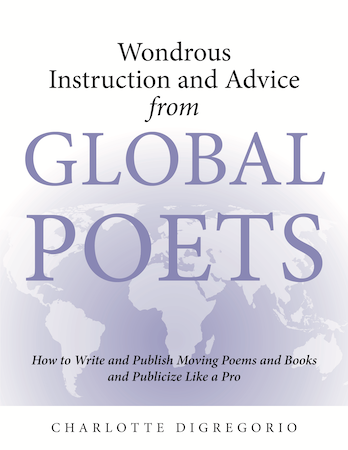
Wondrous Instruction and Advice from Global Poets:
How to Write and Publish Moving Poems and Books and Publicize Like a Pro
by Charlotte Digregorio
27 Essays supported by Illustrative Poems with Analysis ~ 348 pages
Classification: Poetry Writing Reference
Price: $27.95
Publisher: Artful Communicators Press
ISBN: 978-0-9912139-2-4
price at Artful Communicators Press, email artfulcommunicators@icloud.com or you may order from ebay.
Reviewed by Michael Escoubas
Global Poets, by internationally acclaimed educator, Charlotte Digregorio, is a seminal work that belongs on every poet’s bookshelf. It is 348 pages of commonsense advice and instruction on how to get things done in the world of writing and publishing. Moreover, Global Poets is a needed work. While there are numerous excellent resources on one or two topics covered by Degregorio, I have yet to encounter a book that comprehensively covers so many areas of interest to poets.
As a novice poet, all I wanted to do was write good poetry. I had no idea that authoring poems was easy compared to marketing my books, finding a publisher, pricing my book, deciding on my target audience, and so much more. I should have had Global Poets in my hands some ten years ago! Digregorio’s subtitle caught my attention from the get-go: How to Write and Publish Moving Poems and Books and Publicize Like a Pro.
Organization & Format
Global Poets is organized into sections supported by chapters. SECTION ONE: The Nuts and Bolts of Poetry, features chapters that define what poetry is, offers tips that help poets develop and refine their writing skills, how to “think” poetically, starting or joining a writer’s critique group, the value of collaborative relationships within the larger world of the arts such as music and art.
SECTION TWO: Wisdom and Heart: The Short Forms of Haiku, Senryu, and Tanka. Chapters in this section define and discuss these important shorter forms, address misconceptions about them, set forth techniques and thought patterns that, if followed, will yield memorable, if not, life-changing haiku and senryu. Digregorio serves poets and readers alike in the chapter “Writing as Therapy.”
SECTION THREE: Thrive as an Author. Chapter highlights include: Can Authors Earn a Living at Poetry? Nuts and bolts issues get into the weeds of selecting a great title, publishing options, how to organize your book as an attractive product for publication, making contacts with potential publishers, developing PR and other promotional skills, and tips on reaching the maxim number of people with your poetry. In all there are ten chapters within section three, all of which offer practical ideas to achieve success in writing.
Practical Application
Among the most informative and interesting features of Global Poets occurs in Chapter One, subtitled “Elements of Poetry.” Here, Digregorio critiques ten examples of good poetry. These critiques offer insights into how an editor’s mind works. What do editors look for? What poetic devices need to appear in a poem, so an editor knows that this poet has studied his or her craft. I offer “The Wolf,” by Jennifer Dotson, along with Digregorio’s incisive commentary:
The Wolf
by Jennifer Dotson
The wolf caught me by surprise
sniffing outside my door.
I cut coupons and buy bulk,
I protested.
The wolf rang the bell with his slender paw.
I heard his hunger scratching my screen door.
Fairytales forgotten, I let him in.
I didn’t want to be rude.
He sprawled upon the sofa shedding
grey fur on green cushions.
The pantry was bare, the fridge empty.
I offered a platter stacked with junk mail.
Credit card bargains with Lowest Rates Ever!
Catalogs pushing Sheets and shoes and shorts.
Glowing gold eyes sparked shivers
as he rested his head upon my lap.
No thank you, he smiled toothily.
I’m on a low-carb, high-protein diet.
DiGregorio’s commentary:
Dotson’s amusing poem evokes the image of a bored homemaker, letting her imagination loose. It’s a relatable one of universality, of one leading a mundane, domestic life, buried in junk mail and catalogs, behind in chores, grocery shopping, and lacking stimulation from the outside world. Dotson unleashes her creative mind to personify the wolf with zany communication occurring between them. We enjoy the poet’s style with her array of expressive verbs, including those in the lines: I heard his hunger scratching my screen door and Glowing gold ees sparked shivers. Further, “heard his hunger”is an example of synesthesia, using, in this case, the sense of sound instead of sight to describe the scene, the latter as one would typically expect. We would think of seeing the strong jaws of the wolf, ready to bite into food.
Dotson’s advice to poets is: “Keep a notebook for your ideas: possible themes, phrases that bounce in your head, words that you like. This will help you when you want to write but are struggling with what to do.” Further, she suggests: “In this notebook, write down favorite lines from poems. This can be a great springboard into your writing–a response to another poet’s writing.”
This reviewer’s work has been published hundreds of times. I still find in Charlotte Digregorio’s Global Poets, nuggets of wisdom and novel resources for improving my writing. Best of all, Degregorio’s engaging humor never fails to produce in me, a fresh harvest of motivation.
|


