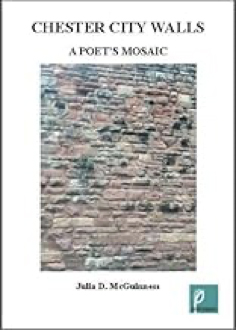
Chester City Walls
Julia D. McGuinness
A sequence of poems in four sections, 76 pages
Price: £7.95
ISBN: 978-1-909404236
Publisher: Poetry Space Ltd
To order: www.poetryspace.co.uk
Reviewed by Neil Leadbeater
Julia D. McGuinness is a therapeutic counsellor and writer living and working in Cheshire, England. She is also a Licensed Reader in the Diocese of Chester and is currently Chester Cathedral’s Poet-in-Residence. ‘Chester City Walls’ is her debut poetry collection but she is also the author of other published works including ‘Writing Our Faith,’ (SPCK, 2013) which was written to encourage the practice of personal writing on the Christian spiritual journey.
Chester’s city walls are the oldest, longest and most complete in Britain. Their construction was started by the Romans as a defensive measure when they established the fortress of Deva Victrix between 70 and 80 AD. Originally a rampart of earth and turf surmounted by a wooden palisade, they were reconstructed using sandstone, but were not completed until over 100 years later. Following the Roman occupation nothing is known about the condition of the walls until Æthelflæd re-established Chester as a burgh in 907. The defences were improved under the Saxons. After the Norman conquest, the walls were extended to the west and the south to form a complete circuit of the medieval city. This circuit was probably complete by the middle of the 12th century. Chester is the only city in Britain to retain the full circuit of its ancient walls. Walking the complete length gives us a unique view of the city as well as a fascinating insight into its long history.
The full title of this collection is ‘Chester City Walls: A Poet’s Mosaic’. The mosaic is to be found in its structure and symmetry. The collection, which may be viewed as a single poem, is divided into four sections which correspond to the four main gateways: Northgate, Eastgate, Watergate and Bridgegate, by which access may be gained on to the walls. Within each section, there is a poem whose title begins with the word ‘Traversings’ and there are a series of poems titled ‘White Lines on Blue Metal’ with accompanying illustrations. The word ‘traversings’ has a special meaning here. In architectural terms, it can refer to several related concepts, for example, a survey method using intersecting lines for mapping or a barrier or wall designed to intercept explosive fragments.
Either end of the book there is a prelude and an afterlude. An interlude marks the halfway point of the journey. It also marks the place where a section of the wall is no longer standing:
And so it comes to this, down from Bridgegate
onto level road as Wall seems to disperse,
sprawl flat as an oil spill: The ‘almost
complete circuit,’ the tourist guide foretold.
Colourful sketch maps guide the reader along all the sections of the wall. The attention to detail that has clearly gone into the planning of this book is impressive.
McGuinness weaves a mosaic of different but complementary verse forms throughout the text which includes a villanelle (‘The Wishing Steps’), a sonnet (‘Sonnet of the South East Aspect’), a list poem (‘The Wisdom of the Water Tower’), a prose poem (‘Walls by Numbers’), a reverse poem (‘On Reading the Murengers’ Rolls of 1441’), free verse and rhyme. Time also runs through this collection as we touch upon the Roman founders, the Viking invaders, the Anglo-Saxons, the English Civil War and the present day. These are the threads which McGuinness draws upon to stitch a tapestry in poetic form.
Judicious use of consistent imagery makes its appearance right at the start. In ‘The Prelude’ it is playing cards: ‘Walled city: playing-card compact, / defined by ranks of Roman spades / ramparting turf and timber lines / till Empire’s eagle fluttered, fled.’ In the following verses, we have a ‘baize plain,’ ‘Queen’s faces’ that have ‘graced the pack,’ while other words such as ‘diamond’, ‘face-up’ and ‘clubs’ keeps the image alive.
‘Walls by Numbers’ imparts a lot of history and factual detail in an accessible form. As its title suggests, almost every line contains a number and makes for a fascinating read. Other poems full of fascinating facts include ‘Walls by Oddments’, ‘Properties of New Red Sandstone’ and ‘Walls by Adjustments’. Another poem that caught my attention, ‘Noli Me Tangere,’ is all about the work of hands, hands that interacted with stone to build the walls:
once
they were pounded out of home,
held down, hammered and split.
Slower hands healed their trauma,
gifted shape and colour with kinder tools.
Some of these stones are now museum pieces, ‘sheltered in a gallery, open to visitors’ / view. But never to be touched.’ I like the way the poem comes full circle from the title right down to the words of the last line. Once again, time and history have moved seamlessly through this poem.
In ‘Traversings:….To Promenade’ the satisfying use of consistent imagery that I referred to earlier is once again evident. This time it is on the theme of walking. We find it in the title, ‘promenade’ and in the words ‘heel,’ ‘stride,’ ‘ankle,’ ‘stroll,’ ‘pace,’ ‘distance,’ and ‘walks’. Alliteration is employed to good effect in the opening lines:
Canal turns heel at southern shift of Wall
and I discern a sea-change in my stride
This alliteration is repeated at the end in the single final line:
In denim’s duller hue I trace their walks.
In the opening stanza of ‘Liturgy of the Hours’ there is an echo of lines from Psalm 24:
Unlock the Kaleyards’ gate
that the King of Glory may enter
and his servants go out in safety!
Another Biblical echo is to be found in the final line of ‘Interlude / Traversings’ where the author catches a whisper: ‘This is the way, walk in it.’
Homage is paid to historic / symbolic objects and their depictions in metal engravings which take the form of white lines on blue metal plaques: a phoenix, a decorative cross, a Roman helmet and sword, a merchant ship, a fortified gateway, a cannon and the Eastgate clock. Each of these vignettes, confined to six lines, in which the first line proclaims the subject in bold type, is a miracle of compression. Here is the Eastgate clock:
Eastgate Clock:
Roman-numeralled, guilded,
City’s long-service watch
holds steady the hours; empowered
to halt steps of tourists, swiften
the time-pressed.
The word ‘watch’ here, positioned at the very centre of the poem is loaded with meaning reminding us of the whole purpose of the wall when Roman soldiers stood watch of the city.
Walking the walls provides us with a unique perspective as we pass the many places that are adjacent to it: the Shropshire Union Canal, the River Dee, the Agricola Tower and castle walls, a bowling green, some tennis courts, a water tower, a Roman amphitheatre, the Merseyrail Wirral Line and Chester Race Course, known as The Roodee, where ‘horsemen speed the field like torpedos. / Hooves pound past the Wall; flanks ripple / under whips of hunched silks. The army sprawls the plain.’
People past and present populate these poems with anecdotes and snippets of dialogue: a hot-air balloonist, Edmond Halley, Hugh, first Norman Earl of Chester, a couple of students, a jogger and ‘a bunch of suits drinking outside The Architect’. The wall itself is even portrayed as a living being, appearing with the status of a capital ‘W’ whenever it is mentioned in the text.
During the course of McGuinness’s walk along the wall she asks this central question, a key perhaps to the whole collection:
I wonder where true centre lies, and if all
our walking to and fro is quest for the elusive poise
between the innerness and outerness of things.
A good philosophical point, perhaps, on which to end this review. |


