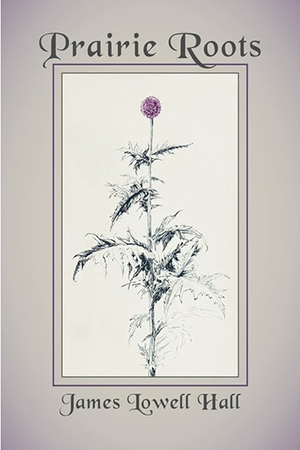
Prairie Roots
by James Lowell Hall
60 Poems ~ 17 B/W Illustrations ~ Dramatis Personae ~ 133 pages
Price: $18.95 ~ Perfect Bound ~ Softcover
Publisher: Shanti Arts Publishing
ISBN #: 978-1-962082-12-9
To Order: Amazon.com
Reviewed by Michael Escoubas
Prairie Roots is the story of a town, a home, a family, and a legacy. Told with poetic charm and treasured photographs, the story begins in 1915 in the town of Delavan, Illinois. This was the year Ray and Marguerite Lillibridge, the author's grandparents, got married. From that time forward, joys and trials were lived and shared, then told and retold, until they became the treasured foundations of a family rooted in the prairie soil of central Illinois.
The collection is structured into three divisions: I. Prairie Dawn (28), II. Sun and Air (24), and III. Green Sod Above and Lie Light. The poems are neatly gathered to reflect the historical context of each division: Birth, Maturation, Reflection.
This review seeks to highlight a family whose legacy might best be described as love. James Hall, now a practicing attorney in the Chicago area, writes, as it were, with a fountain pen filled with the ink of love. I say this, not because I know the poet personally but because of Hall’s testimony in his “Acknowledgements” page:
“What do you want for Christmas, Jamie?” my mother asked my four-year-old self. “People and books,” I replied. And for sixty years, save one, I have gone to Delevan each Christmas season for the people. The cacophony of aunts, uncles, racing cousins–was joy for an only child.
This same joy, inspired by the Lillibridge tribe, is a hallmark of Hall’s poetry. The first poem is about Hall’s grandmother who, on her birthday,
My grandmother greeted
family and friends, opened letters
from three US Presidents, quoted poetry,
helped two great-grandchildren
blow out one hundred candles.
Marguerite set a loving tone which came to be foundational:
Happiness in marriage–that’s not something
just happens–it’s being the right partner,
not marrying the right partner.
Ray, Marguerite’s husband:
Grew up on the plains, lived through the Children’s Blizzard, prairie fires, tornadoes, the woeful sound of hateful wind, dust storms, droughts, grasshoppers that blotted out the sky, times when all the family had to eat were tomatoes and cabbage. Most of the cattle in the West died during the brutal winter of the Great Die Up. Ray survived.
These two hearty people, familiar with suffering, became pillars that inspired and supported a family and a community through the course of generations.
“Hogging Catfish” is about a real life (though the stuff of legend) named William “Hog” Wallace. In brogue typical of the times, Hall tells the tale about Hog:
Look catfish have their home in sunken holes,
you need to go down into their haunt
and tickle them just right. When they feel
comfortable with you bein’ there,
sneak your left hand up into their mouth
like to kiss ‘em. They’ll wake up in a tizzy
realizing’ you ain’t their mama catfish,
sweating bullets to get out of that hole
they’re in. Expect that fish to reflex
jerk forward and chomp on your hand.
Each poem reflects the way things were at a time and in a place one would like to be. “Main Street Saturday Night” is one such place:
We each were given a dime on Saturday
opening a universe of possibilities.
All the stores stayed open and people
flocked into town. Mr. and Mrs. Reynolds
set up a popcorn stand on Reinheimer’s
corner and soon after lighting a little stove,
sounding like small firecrackers, popping began.
Your reviewer grew up in a small town near Delavan. In these, my mature years, I often reflect upon my small-town heritage … Saturday nights in town was one of those gifts.
Titles such as “Chicken Every Sunday,” “First Day of School,” and “Monday Wash Day,” speak into the depths of my heart. They reveal truth about character formation, family fun and family suffering. It was the suffering that caused the most growth.
“Black Thursday” is about the Great Depression setting in. Delavan’s banks fail; dreams and hopes once assumed are dashed. For the Lillibridge family:
Two gardens, a big strawberry bed,
keep our table full:
rows of string beans, beets,
corn, carrots, peas, cucumber hills,
four apple trees, two cherry trees,
two grape arbors, white and red.
The Lillibridge family reached out to the Delavan community at large, helping, giving, sustaining when there was:
No money to build houses.
If barns and silos need repair,
folks try to fix it themselves,
before hiring Dad, then asking
him to put their bills on the books.
Toward the end of the volume, Hall salutes the memory of his father and by extension his family legacy … a legacy built on unshakable values of faith, family, and service. “To a Father Dying Young” details a dream in which Hall waits at a restaurant, along with a large party, to be seated. His father appears across the room in conservation with a friend. In a supernatural moment, his father:
Stopping his conversation, he smiles,
sage green eyes penetrate mine,
connect in familiar quiet ease.
A checkered table for two opens.
I think I should grab Dad and take it.
The two of us could sit and reminisce …
The dream ends before we get a table.
I wake, pillow damp, spent, longing.
So many questions never answered.
Washing sleep from my eyes,
in the mirror, Dad’s face looks back at me.
It is little wonder that Prairie Roots won Book of the Year, awarded by the Illinois State Poetry Society for 2024. It is rooted in the rich prairie soil of truth and love.
|


