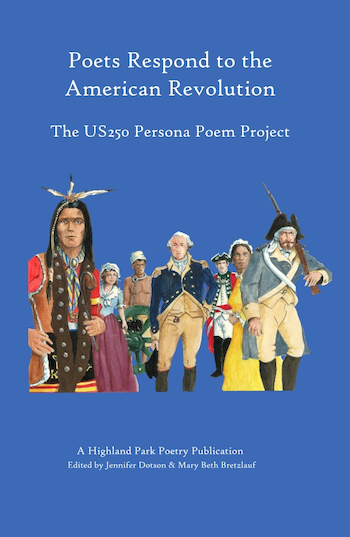
Poets Respond to the American Revolution
The US250 Persona Poem Project
101 Poems ~ 184 pages
63 Participating Poets
Cover Illustration: Cheryl Steiger
Cover Layout: Jennifer Dotson
Price: $18.00
Publisher: Highland Park Poetry
ISBN-13: 979-8-9880919-9-8
To Order: Amazon.com
Reviewed by Michael Escoubas
I identify as a child of the turbulent 1960s. This decade included the assassinations of John F. Kennedy, Robert F. Kennedy, and Martin Luther King, civil rights violence throughout the South, President Lyndon Johnson’s landmark social legislation The Great Society, and the Vietnam War. Memories of the war linger: a nation fractured by dissent, the rise of so-called flower children and the “Hippie” generation. Many folks questioned the stability of the American experiment. Our democracy survived the test. Fast forward to the present moment. America finds herself in turbulence again; this time it is the turbulent ’20s. America is divided by vitriolic political rhetoric, hate speech, so called “fake news,” violence over immigration policy, allegations of social service fraud, and much more. Many question once again the sinew of the Declaration and the U.S. Constitution.
In this pivotal moment, Highland Park Poetry gets into the conversation with its US250 Persona Poem Project, Poets Respond to the American Revolution. In this remarkable anthology, sixty-three poets assume the personas of period characters. These real people express what they are thinking and suffering as they shepherd a fledgling nation through her birth contractions.
The collection opens appropriately enough with “Trouble Brewing: 1765–1775.” Seeds of rebellion have been planted, and roots of unrest reach deep into the colonies’ soil. Poet Jill Spealman becomes Boston’s “Tree of Liberty.” Hear her voice ringing in these excerpts:
I’m stately, yes, and I touch the sky.
I’m an elm, ulnus americana.
My roots run deep, I’m a native here,
I shade citizens and beasts.
For over a century I’ve stood in this grove
in the growing town of Boston.
This important stage-setting poem points to early causes of unrest. These included populist anger over suppressed liberty, unfair and unrepresented taxation, divided loyalties between those who backed the king and those who didn’t. People gather under the “Tree of Liberty,” hang lanterns on its branches, shout their opposition while perched on its branches. Spealman’s poem ends portending what is to come:
Everyone can speak and it’s obvious
that the people have the power.
Through grit, through sweat, through confidence
the people have the power.
Kim Reed, assumes the persona of George Robert Twelves Hewes, whose impassioned voice unveils the colonists’ determination to resist British imposition of taxation without repre-sentation:
The British said the taxes and tariffs paid for our defense.
But now, as patriots, we organized to defend ourselves against
the tyranny of that taxing crown that burdened our lives,
like a crown of thorns on every cup and bowl of tea poured.
As the poem develops, Hewes spews forth his heightened conviction for their righteous cause. Dressed as Indians he declares:
We cut and split every chest of tea in three holds, open
spilling, leaving no ounce safe from the ruinous salty water.
Tomahawks swung high, surrounded by British iron clad ships,
Yet no effort was made to resist these wild assaults in the mist.
One of the lesser-known themes of the Revolutionary period was its vociferous anti-slavery movement. Janea D. Harris channels the heart of The Pennsylvania Society for Promoting the Abolition of Slavery. Formed in 1774, this group helped pass the first anti-slavery legislation of the United States. She writes with undiminished conviction in her poem “Ally”:
No longer can my eyes pretend not to see,
The burgundy hued flesh bulging from deep beneath the layers of your
decadent brown skin.
No longer can I pretend not to hear,
The gut-wrenching cries of the enslaved woman as she labors the entirety
of 22 hours.
Eventually birthing a child that she will never be allowed to hold,
Whose love she will never be allowed to know.
No longer will I fail to support your right to freedom, your right to exist,
Your right to birth and love your children as I love mine.
My God directs me to love my fellow man, without judgement.
I am called, I am moved, I am dedicated to advocating on your behalf,
I am your ally.
Mary Beth Bretlauf is Rachel Walker Revere, the second wife of Paul Revere. She stands straight and tall as a woman of action in her poem “Secrets and Silence”:
No man can ever understand
what we women do to keep our families
functioning and together
… …
Dripping candle wax seals secrets,
midnight knocks on our door,
welcome whispered warnings,
notes slipped into my hand
while on my errands,
my husband running messages
under the inkiness of many nights
The collection, taken as a whole, is like walking along a giant panorama. Even the titles suggest suffering and privation for the cause of freedom. “Brown Beauty,” by Elaine Person, is about the horse borrowed by Paul Revere for his midnight ride. “My nostrils flared as I ran that night.” Julie Isaacson’s “Building Heart, Building Home,” captures Polish immigrant Haym Salomon’s love of America. He takes bold actions and bold risks to join America’s struggle. There are poems about spies. Jan Chronister’s “The Capture of Nathan Hale,” takes readers into the very tavern where the traitor betrays his mission. There are epistolary poems, intimate writings about sufferings and heartaches of war. These poems visit ordinary things recovered amid the violence of war. Terry L. Slaney’s “All My Earthly Love,” is an emotion-filled letter leaving a few items as reminders of his love: brass buttons, small lead musket balls, a powder horn, his blood-stained uniform. On it goes in panoramic splendor, the experiences of people, places, objects of endearment, the simplest things from which a nation was forged.
Mary Beth Davis Ashley’s poem, “I, the Bell,” fittingly, the last poem in the collection, sums up the heroic, yet complex themes that characterized America’s birth and her yet-to-be-fulfilled legacy. This poem is worth the modest asking price. The Liberty Bell, herself knows that what began 250 years ago, was imperfect. It challenges those of us in its posterity to never stop striving toward its ideals.
Editors Dotson and Breztlauf are to be congratulated for their astute gathering of poems. Their selections exemplify what it took to build a nation and a legacy worth living for … worth dying for. The sixty-three contributing poets, likewise, deserve praise for their literary acumen in writing persona poems. Were this reviewer teaching a college-level course on either the persona form or the period’s history, The US250 Persona Poem Project would be a required text.
|


