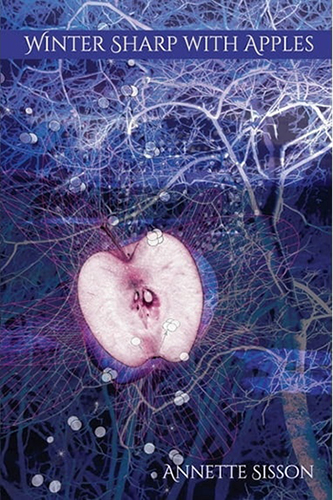
Winter Sharp with Apples
by Annette Sisson
45 Poems ~ 103 pages
Format: 6 x 6 ~ Perfect Bound ~ Paperback
Price: $15.89
Publisher: Terrapin Books
ISBN: 978-1-947896-75-8
To Order: Amazon.com
Reviewed by Michael Escoubas
As award-winning poet and Professor of English, Eduardo C. Corral has noted: “Annette Sisson’s poetic gifts are on full display in Winter Sharp with Apples. Her language is crisp and clean–a readability that’s instructive, a readability rich with emotional and intellectual pleasures.”
This reviewer’s heart has been challenged by Sisson’s wise insight into life. She employs poetry much like a seasoned carpenter whose precision and artistry displays an artifact that is both beautiful and useful.
Sisson’s latest triumph is organized into four sections: I. Unburying the Roots, II. Limbs Propagate in the Split, III. Woodlanders, and IV. Epilogue.
I begin with the title: Winter is the coldest season. Apples are a product of summer. Thus, we live within Nature’s polarities. Sisson leads her work with an epigraph by Walt Whitman, excerpted from Leaves of Grass:
“The pleasures of heaven are with me, and the pains of hell are with me.
The first I graft and increase upon myself. The latter I translate into a new tongue.”
Whitman, no stranger to suffering, serves to ground the poet in reality. “Origin Story,” Sisson’s foundational poem, places the poet lying in a field on a “frayed quilt” contemplating “jeweled studs of stars, nebulas in haze.” She, “aches to touch life’s nucleus.” She dwells where “Galaxies of cells spiral, [where] cobalt and amber / whirl into green.” Winter Sharp with Apples, develops and amplifies a poet whose “fibrous lungs teeter on the edge of breath.”
“Nature Almost Holds Us,” is a creative gem in which “Winter” is supplemented by “Apples” … here’s an example:
The surgeon chisels a tiny hole
in my father’s good eye, fashions
a thin flap to cover the pit–
a pot of churning liquid, lid
placed askew, tension releases.
Night’s cloudy tarp, curve
of thin light–too little to see
the bird’s angle of light, only
the whoosh and flap above my head–
thrust of air, beats recede.
I too, connect poetically with the natural world like a good friend coming alongside or as a prayer which sustains me, or marvel at how Nature mirrors life.
While there isn’t a poem I did not like, several poems were powerful for me in Section II. This section is about real-life splits. They are about trouble in families, death, dealing with childhood trauma and more. Sisson’s work hits us where we live but does not leave us in despair. She shows how limbs propagate in the split.
Sission lives and teaches in the Mid-South. In “First Morning, 2023” the poet grounds herself in the region’s life sustaining beauty:
In the Blue Ridge mountains
granite swells its barrel
chest along the roadside.
Strands of clouds sheath
valleys, swallow trees
up to their crowns.
Blue-gray hills convene
in haze, and patches of bare
brush congregate on nearby
slopes, ringed in white
light. Already morning
kindles spent embers,
marrow of bone and earth.
“Our Hands” deals with the impending death of a grandparent, and “you recede / into silver mist, a grandchild will be born.” The poem goes on to point out that though death has happened “I will touch this baby–and he will be yours. I will cradle him in our hands.” You feel it … you feel what the poet means by Winter Sharp with Apples.
“Blue Spruce” channels the section title as the poet works out grace amidst family trouble:
A somber autumn, season of drought
and divorce. I read about cleft grafting,
wonder how limbs propagate in the split.
You arrive in your silver Chevy pickup,
bring a Colorado spruce for my blue-
eyed son, shoulder it inside,
clip the low sprigs, shimmy
trunk into metal, rotate, lock it
down. I had shunned Christmas,
the shuffling through trim, boxes
of painted fragments, too sharp,
too heavy to open. You splice
strands, weave spangled light
into branches, needles soft. The tree
settles, stretches for tinsel and beads.
Maybe a braided nest of eggs,
sky-blue, to roost in an elbow’s bend.
The poems in this section and throughout the whole, are laced with the stuff of real life. “Late” is about a mother and daughter’s conversation about abortion. The ending surprised me. What sticks with me is that thirty years passed before a long overdue talk finally took place. How often does life go this way? This is the talent of Annette Sisson: she knows and writes about where her readers live.
Readers: Don’t delay in ordering your copy. This is where we ask:
What propagates next? Obsolescence
Inertia? Love? What to do
but claw across the ice, debate
how much a vessel can bear,
if rock and cloud will pull us under
into winter’s frigid rush, into drifts–
sleep, the tang of desire, of apple.
|


