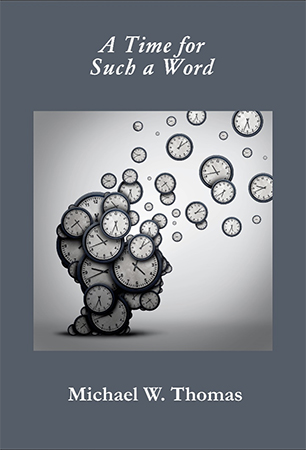
A Time for Such a Word
by Michael W. Thomas
53 poems, 99 pages
Publisher: Black Pear Press, 2024
Price: £8.00
ISBN: 978-1-913418960
To order: www.blackpear.net
Reviewed by Neil Leadbeater
Michael W. Thomas is the author of nine collections of poetry, three novels and two collections of short fiction. For a number of years he lived in Canada but he now lives in Worcestershire, England. From 2004 to 2009 he was poet-in-residence at the annual Robert Frost Poetry Festival, Key West, Florida. He has published on the poetry of Robert Frost and W. S. Merwin, the fiction of Elizabeth Bowen and William Trevor and the drama of Joe Orton. He has reviewed for a number of journals including The London Magazine and The Times Literary Supplement and is on the editorial board of Crossroads: A Journal of English Studies (University of Bialystock, Poland).
The title of this latest collection is taken from Act V, scene v. of Shakespeare’s ‘Scottish play’. It is Macbeth’s response to Seyton’s message that ‘The queen, my lord, is dead’ and it immediately precedes his famous lines beginning ‘To-morrow, and to-morrow, and to-morrow, / Creeps in this petty pace from day to day, / To the last syllable of recorded time…’ True, there are dark moments in some of these poems by Thomas but there is also much light and hope as these lines reveal in ‘By Way of Testament’: ‘…turns out you can love life / but still find from its earliest strokes / that you’ve been marked out for excessive shade’.
The collection is divided into eight sections of unequal length whose sub-titles are often but not always found in subsequent lines of verse. Subjects range from family relationships and childhood memories, to ‘round the houses lyric[s]’, meditations on time and mortality in settings that are both urban and pastoral reaching over several generations. These are poems that do not yield everything up at once. In other words, they have to be worked at line by line for their full meaning to be understood.
The opening poem, ‘A Year to Speak’, suggests that the collection was put together over the space of a single year. Its subject matter is the word itself which, when put together with other words, might result in anything from an afterthought to an echo, a remembrance or ‘a prayer, perhaps, / that quivers like a globe of midges’. The conversational tone is in keeping with his style. The last line of the opening poem is almost in keeping with Macbeth’s famous lines with which I began this review: ‘lordy, lordy, here’s another day’. The theme returns in another poem, ‘That Time’ with the line ‘The day will maunder on’. The word ‘maunder’ is such a good fit to describe how the day will wander on its way slowly and idly; how it will grumble on.
Thomas is particularly good at evoking atmosphere. At every point, the reader feels that he is in the poem itself, breathing the same air and seeing the same things as they are being revealed. The way Thomas stretches our imagination with his original lines, what I term as ‘writing outside the box’ is refreshing. He always surprises and delights us with memorable imagery. Here, by way of example, is the opening to a poem titled ‘Deeper In, Further Off’:
I’ll always remember that garden.
The branch-hands of the ornamental pear
scrabbling at high winter,
knocking each other out of the way
as if mad for the last bun on the plate.
The starting points of his poems are often ordinary enough - a boy looking out of his window at dusk, an unexplored country lane, a drive through the Welsh Marches where ‘road signs play tag with two nations’, the forecourt of a busy petrol station, the sudden sighting of a blackbird from a kitchen window or a woman killing time in a station buffet -but all of these poems end up in unexpected places. Following the trajectory of each journey makes for a very satisfying reader experience.
Most of the poems take the form of narratives in which we are told a part of a story, the remainder being left up to our imagination. ‘Like the First Bird’ is a typical example of how one of these poems begins. Within the first five lines, the scene has been set to great effect, making us want to read on:
A man gets off a train in a town he doesn’t know.
Already others are pulling their mornings
around them. Light hollows channels
for first footsteps, the drag of crates
to hold shop doors ajar.
A long poem called ‘Safe’ explores the notion of an Englishman’s home being his castle through the eyes of a young child. That ‘castle’ might be a rectory or some other place of seclusion ‘where the brickwork / smuggles comfort in’ for another night, a place populated by housekeepers and kind strangers, a place where nobody asks you to do or be a single thing.
Thomas’s meditations in later life, as shown in these stanzas from ‘Quiet in Whitened Space’ are, for me, one of the highlights of the book:
Come a certain time I may simply stand,
dust off the moment’s particulars,
go to sit in a quiet space
and be about my salvation…
…I’ll lean against (as it might be) an elm,
so far back I’m all but hooped within it,
lost in the first of summer
with the bulbous drowse of its one wasp
looping round the hours…
These are finely crafted, thought-provoking poems, often reflective, sometimes humorous, but always arresting and original. Highly recommended.
|


