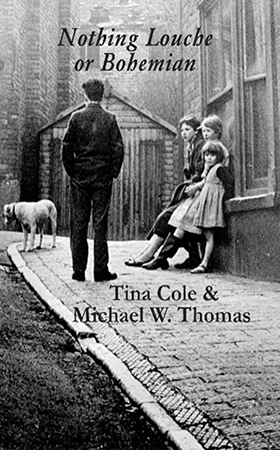
Nothing Louche or Bohemian
Tina Cole and Michael W. Thomas
28 poems, 41 pages
Price: £7.00
ISBN: 978-1-916910270
Publisher: Black Pear Press
To order: Amazon.com.au
Reviewed by Neil Leadbeater
Tina Cole was born in the Black Country and now lives in rural Herefordshire near Ludlow, England. She has three published pamphlets, I Almost Knew You (2018), Forged (Yaffle Press, 2021) and What it Was (Mark Time Books, 2023). As a poet and reviewer, she has led workshops with both adults and children and judged a number of U.K. and international competitions. She is a past winner of a number of national poetry competitions, 2010-2023, and completed an M.A. in Creative Writing / Poetry at Manchester Metropolitan University in 2023.
Michael W. Thomas has published ten collections of poetry, three novels and two collections of short fiction. His most recent poetry collection, prior to this, is A Time for Such a Word (Black Pear Press); his most recent short fiction collection is Sing Ho! Stout Cortez: Novellas and Stories (Black Pear Press)and his most recent novel is The Erkeley Shadows (KDP / Swan Village Reporter). He was long-listed for the National Poetry Competition, 2020 and 2022, and long-listed and short-listed for the Indigo Dreams Spring Poetry Prize, 2023. From 2004 to 2009 he was poet-in-residence at the annual Robert Frost Poetry Festival, Key West, Florida. He has published on the poetry of Robert Frost and W. S. Merwin, the fiction of Elizabeth Bowen and William Trevor and the drama of Joe Orton. He has reviewed for a number of journals including The London Magazine and The Times Literary Supplement and is on the editorial board of Crossroads: A Journal of English Studies (University of Bialystock, Poland).
I am often drawn to poetry books with unusual titles and this one is no exception. My dictionary defines ‘louche’ as ‘something that is disreputable or sordid in a rakish or appealing way’ and ‘bohemian’ as ‘a socially unconventional person, especially one who is involved in the arts.’ Both words make their appearance early on in the book in Cole’s poem ‘Intoxication’ where she imagines spending ‘evenings in cerise silk pyjamas, / something louche, bohemian, a life away from corseted / cares. Listening to Rachmaninov, nights at the Royal Opera / not the sixpenny stalls at the Sedgley Clifton.’ This shift from reality into make-believe is all to do with ‘the way you look at things, / in the way one’s hand reaches out for beauty…’
Many of the themes underlying these poems mix personal experience with social history in a vivid and engaging way that somehow never gives in to nostalgia but always ‘tells it as it was’.
The authors have chosen to dedicate their book ‘to those people and places that, for good or ill, have haunted our rear-view mirror.’ By way of introduction, we are reminded that memories can play tricks on us, that the substance of what we actually remember is not the same thing as the original event but a reconstruction from the last time that we remembered it. On this reckoning, ‘memories are like copies from a printer whose ink is giving out’ but whose persistence down the years is still remarkably tenacious. Reading this collection we are reminded of the things, some seemingly trivial, others larger than life, that continue to have a hold on us.
Scanning the contents page there are several titles that bear the names of specific individuals while others are about places known to one or other of the authors. Most, if not all, of the scenes derive from childhood, from that age when we are all at our most impressionable, the time when we are shaped by events without even being aware of it.
I was fascinated to learn that the authors, who have known each other for several years, not only grew up in the same area of the Black Country but also went to the same secondary school. It was these coincidences that prompted Cole to suggest that they should collaborate on a project together thereby leading to the publication of this collection. There were times when I was hard-pressed to guess which of them had written a particular poem because their approach to their subject matter was so finely tuned and woven together. A note at the end listing the titles of the poems by author (fourteen each) satisfied my curiosity.
Early on in the collection we are back in the year 1962. Thomas’s father is in his Thames van heading for John Thompson (Boiler Makers) Ltd, the factory where he worked on Ettingshall Road, Wolverhampton.
Only now, years later, do I wonder
how he kept his head distracted
as the dawn roads of Coseley
gave way to Bilston’s ice-pans
and the sodium-lit boulevards
of Upper Ettingshall.
The surface slabs of ice on the roads at Christmas and the cold glare of the sodium lamps are vividly portrayed here, while the foreign-sounding word ‘boulevard’ gives the whole verse a sense of unexpected grandeur when in reality what is being referred to is a wide road in an urban sprawl of West Midland factories and warehouses.
Cole’s ‘These I have Loved’ is equally captivating as it moves in to focus on specific scenes, places and events in a fast-moving list poem:
Foundries spitting soot / chained ponies on nettled wasteland /
Midland Red 272 / upturned boat bridges over the rainbowed
canal / bag of chips 6d / markets illuminated by paraffin / bargains
second hand and salvage / kids with hands and hair unschooled /
the wisdom of shallow pockets /
In the industrial West Midlands we are never far from canals. Thomas’s ‘Ivyhouse Junction’ speaks of ‘buffer tyres’ riding ‘the basin water,’ ‘a bike-boy on the marina’ and the sighting of ‘a single swan / the sun’s approbation prinking its neck’.
Cole’s ‘Canal Bridge 236 – Betsy’s Tale’ unravels a story of night-time assignation’s beneath a canal bridge. This poem is so powerful it almost reeks of dampness and sadness as you plumb its depths. It is place full of ‘wide mouth gaping men / echoing their little deaths into a hollow world / of fur coats and fishnet tights’…but there is more to it as we hear Betsy’s side of the story:
….For years she spat barbs
another scaly skin shrugged on, shrugged off.
She wanted the whole gamut of beauty, so kept
fishing, reeled in anything life had to offer.
236 was her childhood favourite where kind trolls
waited to grant wishes.
This collection is very much a product of its time. There are shepherdesses on mantels, Start-rite sandals for school, grey gaberdine raincoats (two sizes too big, of course), initialled handkerchiefs, adverts for Pepsodent emanating from the TV, soap called ‘Knight’s Castile’ and the smell of ‘Old Spice.’ All these things, in their own particular way, act as memory-joggers, bringing the past back into the present for a fleeting moment.
Teachers, pupils and classes are all recalled with precision. Whether writing about bridleways in Baggeridge Wood, a local vagrant, the art of knitting, a teddy bear with a missing ear or a trip to Coseley Baths for a swimming lesson, the authors draw us in to a time that was very much their world and my world. Highly recommended. |


