Interview with Maryam Imogen Ghouth
by Neil Leadbeater
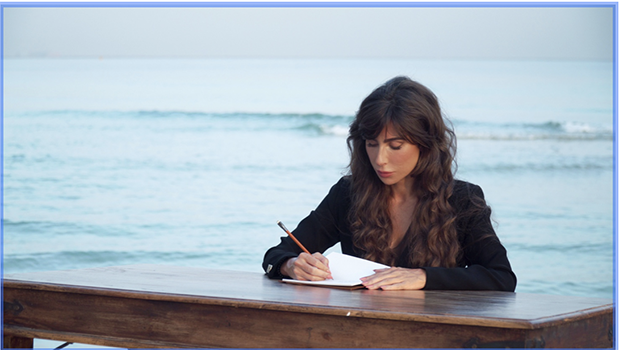
Maryam Imogen Ghouth is a British multidisciplinary artist and writer working across visual, audio and written poetry and prose. She holds a first-class BA Honours degree in Communications, Authoring and Design from Coventry University. Her work, which offers reflective psychological insights as a means of reconciling some of life’s intimate complexities, weaves writing, audio, and visual story telling into layered expressions of wisdom and beauty.
She is the author of ‘I Ask My Being: Reflective Poems On Staying True’ and the recipient of many literary awards including most recently first place in the American Writers Review Award, first place in the Earth Amulet Poetry Prize, and first place in the London Director Awards. She divides her time between Norwich, Mallorca, and Dubai.
----------------------------------------------------------------------------------------------------------------
Maryam, I am fascinated by your creative journey spanning as it does so many different aspects of the arts. How did this journey begin?
It began in the wake of an existential crisis. What started as frantic, unstructured outpourings—charged with philosophical and psychological inquiry—gradually found cohesion in free verse. From then on, poetry became both a means of reckoning and orientation. There was something about the restraint of form that freed me. The page became a deliberate boundary within which the unbounded could be examined.
In time, that expression moved beyond print to encompass sound through audio poetry, and eventually, the visual dimension followed, where film emerged as a medium I engage periodically and as an extension of the same impulse: to give shape to what once felt formless.
Your poetry films, most notably ‘Not Alone’, have received 11 first-place awards and six honourable mentions, screening at art houses such as Akil in Dubai, art weeks such as DIFC Art Night in Dubai and 39 film festivals worldwide, including Poetry in Motion, Emirates Film Festival, Sydney Short Film Biennale, New York Awards and Barcelona Indie. Would you say that the poetry film as an art form in its own right has now come of age and what do you think is driving its popularity?
For a long time, poetry film lived on the margins—somewhere between literature and experimental cinema—but audiences today seem more receptive to hybrid forms that sit between disciplines.
Part of its growing appeal may lie in the pace of the world we occupy. We live in a time where people tend to watch far more than they read because our attention is increasingly shaped by visual and auditory media. Film, social platforms, and streaming have trained us to receive stories through image and sound and, for better or worse, a short film will travel faster than a written poem.
I also think the accessibility of filmmaking technology has played a role. More artists are experimenting with visual language, and poets are increasingly collaborating with cinematographers, composers, and editors. What was once technically difficult to produce is now far more feasible.
At its best, poetry film feels less like an illustration of a poem and more like a third form that emerges between the interiority of poetry and the emotional immediacy of cinema. That intersection is what continues to draw both artists and audiences toward it.
Which of your films are you the most satisfied with, and why?
The latest three poetry films, ‘Not Alone’, ‘Bubble Hat’, and ‘Just Once’, are the ones I feel most aligned with today, particularly in terms of production quality and visual interpretation of the poem, which I couldn’t have achieved without the support of the right team members.
These poetry films reflect one of the styles I am most drawn to: intimate, and it took me years of experimentation to discover. The visual field is intentionally focused on a single subject engaging his or her environment and captured from different angles.
In ‘Not Alone’, for instance, the camera remains with the artist almost the entire time, resisting distraction. That emphasis creates a kind of psychological proximity. With ‘Bubble Hat’, we follow the journey and visual field of a woman who feels disconnected from urban living, and with ‘Just Once’, we witness a kushti fight from start to finish.
Tell us a little bit about your poetry recordings that you have done for short films such as ‘Under The Sun’ by Alla Duhl and for tracks by musicians and producers such as Arash Behzadi. How did you become involved with this type of media?
Audio poetry may be my favourite medium because it allows me to create a space one can enter with closed eyes. I love the process itself—the way I sink inward and speak from a place that is almost beneath articulation: somewhere older than language. There is something primal about the human voice and, when paired with melody, it becomes transportive.
Funnily enough, this medium came to me by accident. I began recording my poems on my phone simply to hear them back and, by chance, music by Chopin was playing in the background one day. Hearing how music carried the cadence of words birthed an art form that has stayed with me since: audio poetry.
I note that you also make recordings for guided meditations by wellness practitioners such as Ruqaya Ahmed. How did this come about?
I think my mode of delivery lends itself naturally to meditation because it is unhurried, spacious, and at times deliberately solemn. Through collaborations with practitioners such as Ruqaya Ahmed, my recordings began to be used within guided meditations, and many of those tracks are now available on Insight Timer, a global meditation app.
Your poetry is known for its deep sense of quiet and reflection. To what extent would you say that this is drawn from nature?
I often wrest metaphors from nature to better understand human nature. When you observe the natural world closely, you begin to notice a kind of underlying order. Nature, for instance, demonstrates the coexistence of opposites: order and disorder, growth and decay, stillness and movement. Seemingly contradictory forces do not cancel one another out; they generate something new. There is solace in recognising that this pattern extends to us. The contradictions we carry—strength and fragility, certainty and doubt—are not errors in design but conditions of being. In noticing this, I think one begins to feel less estranged from one’s own complexity. Beauty itself emerges not despite complexity, but because of it, and our tensions appear less like errors and more like participation in a vast, intricate design.
But beyond the personal, there is something undeniably miraculous about the natural world, and the attention I give it is the same attention one may find in my poems. That matter arranges itself into forests, oceans, weather systems, and even consciousness is extraordinary, and poetry becomes a way to witness these fascinating elements. It does not need to dramatise existence; existence is already astonishing.
Do you have some kind of creed that you try to follow in your writing and, if so, how would you describe it?
Yes: Pay attention and describe it as it is! I am especially moved by work that truly transmits an experience, even when it is dark, unsettling, or destructive because it is honest.
Do you try to write everyday or just when you feel inspired to do so? Describe for us your writing process.
When I am working on a project, I show up to writing even when I am uninspired. Routine, more than a desk, is what I lean on to produce the work, which includes rituals that don’t involve writing and yet feed it. My day begins with a morning walk, unless it’s a dark winter, followed by an hour of reading five days a week. After that, I sit down to write and divide my time between independent work and commissioned work. I close the day with exercise around 5 p.m. Fridays, however, are looser. In the afternoons, I might focus on submissions or paint or schedule social meetings, whereas during the week socialising is typically confined to lunch hours or evenings.
While I do write standalone poems, particularly when drawn to a journal prompt or competition theme, my routine is most vital when I am working within a larger architecture: a collection, a sequence, a novella. I tend to hold several projects at once, moving between them lightly until one begins to assert itself. When that happens, I follow its momentum to completion, though never in a straight line. The process is more tidal. I draw close to the work, then recede; return to it, then step back again. Each approach reveals something new; each withdrawal sharpens my understanding of what remains unresolved. Through that quiet oscillation, the piece gradually finds its final shape.
What reading, other than poetry, is important to your work as a poet, and why?
Much of what I read falls into two broad categories. The first is literature, whose style and attentiveness to language and the world inspire me. Writers such as Virginia Woolf and Hermann Hesse come to mind—authors whose syntax and way of observing both the inner and outer life can be deeply affecting. Reading them reminds me how carefully language can be shaped to reflect the subtleties of thought and feeling.
The second category is more informative reading. Sometimes that means books about writing itself—Stephen King’s ‘On Writing’, for instance—and at other times works that explore fields I find intellectually compelling, such as cosmology or neuroscience. Stephen Hawking’s ‘A Briefer History of Time’ is one example, as is Iain McGilchrist’s ‘The Master and His Emissary’, which influenced how I think about perception and attention. I am currently reading Diane Ackerman’s ‘A Natural History of the Senses’.
That said, at times my reading also becomes more research-orientated, depending on the themes I’m exploring. While working on a series of pensées on selfhood and the loss of a vital aspect of it: the drive to perform an identity for validation, for example, I return to writers whose protagonists experience a similar estrangement from themselves—Sartre’s ‘The Stranger’ among them—alongside non-fiction that examines the psychological dimensions of that state, such as ‘Feeling Unreal: Depersonalization Disorder and the Loss of the Self’ by Daphne Simeon and Jeffrey Abugel.
That said, one reliable companion in my reading life is Maria Popova’s wellspring of a website, ‘The Marginalian’. Her work brings together literature, science, philosophy, and art in a way that nourishes many of these curiosities at once, and both her writing and reflections are just exquisite.
Each kind of reading serves a slightly different purpose: some nourishes the ear for language, some sharpens craft, and some expands the conceptual terrain from which the poems emerge.
Since you began your creative journey, how would you say your writing and filming have evolved—both in terms of subject matter and the perspective from which you approach the world?
I only embarked on my creative journey about seven years ago, so in many ways it is still quite young. A large part of that time was spent experimenting, trying different forms, flushing myself out, and understanding what I was actually trying to say.
Much of my earlier work was concerned with individuation, which I think was a necessary stage in my development. Over time, however, the centre of gravity shifted. While I am still learning and figuring, the poems are now less concerned with individuating and more with living and articulating the inner and outer worlds we inhabit. They move between describing what the self experiences internally and observing what the self witnesses in the world—and there is much to behold. In that sense, the ‘I’ has become less protective and more observational.
With regard to poetry films, when I first began making them, I always placed myself in the frame as the protagonist enacting the poem, partly as a natural extension of the first-person voice but mostly because that was (and still is) the prevailing mode of our time. In my more recent work, however, while the narration often remains in the first person, using my voice and my words, the figure in the frame is usually someone else. I work with actors or subjects who embody the emotional tenor of the poem, allowing them to enact its verses rather than the poet herself. I’m not opposed to appearing in the work; in fact, there are projects I have in mind where it would make artistic sense for me to be both the voice and the body delivering the poem, but of late, the impulse has been to let another presence embody the poem visually.
Which projects are you involved in at the moment and what are your plans for the future?
I am developing new projects spanning humorous poetry inspired by Wendy Cope; a dystopian novella on animal cruelty; pensées on selfhood in the context of depersonalisation; a collection of poems that wrests metaphors from nature to illuminate human nature; walking meditations on the science of the cosmos; and ‘Envy’, a multidisciplinary, gallery-based body of work encompassing photography, film, installation, and painting. So far, ‘Envy’ and the dystopian novella are in the lead. Meanwhile, I have a couple of short stories/novelettes that need editing, and I am currently submitting my completed memoir in verse to publishers.
My plans are quite simple: to keep refining my craft while cultivating the right constellation of editors, agents, inspiring peers, and collaborators who can both enrich my mind and help bring some of my larger projects more fully into the world. Beyond the work itself, I hope to keep savouring life—and to have more animals in it!
~~~~~~~~~~~~~~~~~~~~~~~~~
Visit her Website at:
https://www.maryamghouth.com
---------------------------------------------------------------------------------------------------------------- |


