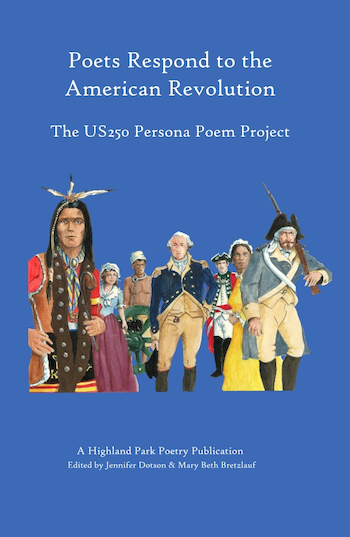
Poets Respond to the American Revolution
The US250 Persona Poem Project
101 Poems ~ 184 pages
63 Participating Poets
Cover Illustration: Cheryl Steiger
Cover Layout: Jennifer Dotson
Price: $18.00
Publisher: Highland Park Poetry
ISBN-13: 979-8-9880919-9-8
To Order: Amazon.com
ABOUT THE BOOK:
Since July 4, 2026, is the 250th anniversary of the signing of the Declaration of Independence, Highland Park Poetry and the Illinois State Poetry Society collaborated to create the US250 Persona Poem Project. We asked poets to explore U.S. history from about 1765 - 1800 leading up to the American Revolution and the creation of the United States of America. This is a big story, and we know there is more to it than what we were told in our high school American history class. We want to meet the heroes, heroines, villains, and witnesses, including those not included in history books.
Editors: Jennifer Dotson & Mary Beth Bretzlauf
ADVANCE PRAISE:
As a student of American History, I have enjoyed books, commentaries, movies, and documentaries about a nation which struggled to form itself. Poets Respond to the American Revolution is an indispensable contribution to the great tradition the arts play in conveying the truth about our Founders’ experiences. What we learned as students in high school history, and even collegiate courses represents but a fragment of the whole. The sixty-three contributing poets in this anthology penetrate the hearts of those who shaped America into a nation that is the envy of the modern world. In poem after poem, they go where few have gone, before or since.
–Michael Escoubas, author of Monet in Poetry and Paint
ABOUT THE AUTHORS:
The US250 Persona Poem Project is comprised of two components: (1) The work contains poems selected by representatives from Highland Park Poetry and the Illinois State Poetry Society; and (2) the award of three $250 prizes selected by guest judge Lynne Viti, faculty emerita of Wellesley College and inaugural poet laureate of Westwood, Massachusetts.
Why persona poems? A persona, from the Latin for mask, is a character taken on by a poet to speak in a first-person poem. Each poem is to capture a moment of this history as told from the perspective of a person living during this time (either fictional or based on an actual person). We asked poets to adopt this form to allow the readers to experience these characters directly and in the moment. Imagine you are having a private conversation with history.
ABOUT THE EDITORS:
Mary Beth Bretzlauf (Editor and Poet) is currently President of Illinois State Poetry Society, a member of Poets & Patrons and Highland Park Poetry’s Live Events and Editorial Teams. She is author The Path that Beckons: Poems About the Journey, her first collection of poems.
Jennifer Dotson (Editor and Poet) is the author of Late Night Talk Show Fantasy & Other Poems (Kelsay Books, 2020) and Clever Gretel (Chicago Poetry Press, 2013). She began Highland Park Poetry in 2007. Her newest collection, The Figs are Ripe and We Have Stories: Poems, will be published this year by Starboard Press.
FROM THE BOOK:
Samuel Adams Speaks of Revolution
by Paul Buchheit
The Stamp Act stirred rebellion, but the reasons fade,
the culprits change. Frontiersmen, farmers, men of trade,
and laborers were subjugated by the rich,
but we were mad, our voices at a fever pitch
inciting commoners against the British tax.
The Boston Massacre was marked by fierce attacks
on local men – the “motley rabble,” rich men said–
with Crispus Attucks famously among the dead.
and then the upper crust, the Sons of Liberty,
arose to rail against the aristocracy
of England, while in Boston tea was dumped in scorn,
and now the apprehensive wealthy rose to warn
the lower classes: “We the People” must unite
against the foreign foe! And speakers would ignite
the crowd, including Patrick Henry, Thomas Paine,
and other rabble rousers: Let us now ordain
a Declaration: independence, nothing less,
equality for those in economic stress
because of taxes. But excluded were the Blacks,
the landless, women, Indians – indeed, the tax
was mainly hurting merchants, yet the poor would fight
while men with wealth could claim a war exemption right.
|


