These Boots Were Meant for Walking
by Elayne Clift
“What will I miss the most?” she wonders painfully, looking at the foreboding building she is about to enter. Juicy hamburgers with fried onion rings, fresh fruit, a soft bed by a window where she can smell spring grass, solitary walks in autumn sunlight, winter’s first snow, a good haircut, sleeping when she wants to, sharing laughter with friends, and taking classes at the Y after her shift at the grocery store. Thoughts of all those things, memories now, flood her brain in rapid succession. “God, how I’ll miss all that,” she whispers to herself.
Her first night in the brick building with bars on the windows and locks at the end of the hallways makes her long for her favorite blanket as she lays on a thin pad that softens her plastic bed. Pummeling her lumpy pillow, she wonders how long she will be able cope until she can leave this place, where soft crying and occasional fights compete. “I will try to be brave,” she promises herself. “Maybe if I follow the rules and avoid trouble, I’ll be out before too long.” She knows that’s a long shot.
The system doesn’t favor people like her. It’s been socialized to believe women or girls who’ve been deeply wounded brought their trouble on themselves, especially when they are so full of despair that they give up sharing their truth. They are bound by rules, constrictions, assumptions and lazy stereotypes, so there is little incentive to hope that a different kind of life is possible. They are already marked as violent females who don’t give a hoot about what has brought them into custody. The people in charge think their custodial charges will never change.
She’s different. She knows that what happened to land her in this place wasn’t good, but it wasn’t evil. It was inevitable, a long-delayed act of self-preservation, an unintentional act that resulted in the demise of someone who’d been hurting her badly for a long time. She harbors hope because she knows that she deserves a better life than the one she’s had, and she’s willing to make it happen.
At night, after her work shift and compulsory classes on things like conflict resolution and anger management, she lies on her bed, trying to ignore the sounds coming from the other three women in her dark, barren room. Two of them are still girls. One is sassy, the other quiet and weepy. She feels sorry for them because they were so young when they did what they did. They like talking to her because she is like a big sister who doesn’t judge them. Instead, she tries to encourage them to believe they can have a good life once they are released from what they dub “the asylum.” She tells them that she understands what happened to them because her story is similar. Without going into her personal details, she says that she’s determined to put it behind her whenever she gets out of this place. Sometimes the two girls smile when she says things like that.
A lot of nights she finds herself thinking about her old, cherished cowboy boots, with their stains and faded, torn stitching. She remembers how she pulled them on quickly when she needed to flee. Those boots were meant for running when it was necessary. She misses them. They made her feel safe. She’d run close to a mile in them sometimes. They had become an essential part of her life. But when their muddy footprint betrayed her not so long ago, they were taken away.
She wasn’t angry at her boots. It wasn’t their fault. She’d had to run so far that she’d stopped for a minute to give her blisters a break. That’s when they caught up with her. They didn’t believe she was running from danger when she told them what happened. She was just a kid making stuff up, the sheriff said. “Not the first time either. She’s a known liar ‘round town. Leo wouldn’t hurt a flea.”
Leo was her stepfather and none of the people she’d begged for help, not the cops, the priest, or her mom could imagine that he was capable of what she told them, not even when she wept and begged to be believed.
On that fateful day, when they called her a sociopath in front of a judge, she understood that what happened to Leo was going to cost her big time because he had fallen backwards on a boulder as she ran from him and had broken his back chasing her. Before he passed out, he told the boys she pushed him “running in them damn boots” to pass him on the muddy path. Now here she was, with no way to get help because no one had believed her.
At first, when she got the news about where she was headed, she tried to remain calm because what had happened really wasn’t her fault, it was Leo’s. Surely someone, somewhere, a counselor maybe, would believe her when she said what had been happening to her. But once she was taken to the brick building with bars on the windows holding on to hope was hard to do. At first she waited months. Then almost a year had passed and still no one had come to her aid.
So, she waited, and waited, and waited some more for a court lawyer to get her out. She followed the rules, did the work she was assigned, and kept herself out of trouble when trouble was brewing. But still she languished, and the time came when she too cried herself to sleep.
That led to dreams about a pair of magic boots that would float down from the ceiling as if an angel had been watching over her and would tell her how to leave. The dreams varied. Sometimes the door at the end of the hallway was unlocked and she just walked out in those boots. Other times the ceiling opened up and the angel took her by the hand and led her out. Once in a dream the two girls pried open the window bars and all three of them escaped. It was hard to wake up to reality in the morning.
Then one day, after missing work because she felt herself spiraling into a hole from which she wouldn’t be able to escape, she decided to take a risk. She would tell her counselor, whom she’d grown to like and trust, what she had never told anyone else, not even the judge who put her in the red brick building, exactly what had been happening with Leo for years before he broke his back while she was running away from him in her boots. When she was finished talking, the counselor took her hand and ran a finger across her eye. Then said she would do whatever she could to change things.
She felt, in that moment, that she might be able to breathe again.
The next time they met, the counselor said, “I’ve been talking to your lawyer and to some organizations that help women and girls like you, and they want to help you now that they’ve heard your story. You’ll need to be patient because these things take time, but given what you’ve told me, and I told them, the lawyer is looking into the way your case was handled. With the support of the groups I talked with, we’re hopeful that we can get you out of here.”
That was enough to make her believe again that what she kept telling the two girls was true: There was light after the darkness of bad times, and a way to begin again.
It wasn’t easy to return to court and tell her story to the judge and the aggressive district attorney who grilled her with insulting innuendos. When he asked her why she hadn’t told the same story in her first hearing, she said, “I wasn’t ready to have another man tell me he didn’t believe me.”
“I could do that,” she said in the debriefing with the counselor and lawyer, “thanks to your help and the women from the organizations who believed me and were there to support me. You all understood that I was a survivor, not a victim.”
When the decision came down from the judge two weeks later, it seemed that he too believed her. He declared that he would consider her time at the red brick building sufficient time served given her testimony. He would ask the governor to agree and release her.
“It will take a bit of time,” the lawyer said, “but you are on your way out.”
After she hugged him and the counselor, she raced to tell the two young women she’d taken under her wing. “I’m leaving here sometime soon!” she said, hugging them both at the same time. “I’m really leaving!” Then she added, “I’ll do everything I can to get you two out of here too, and to help other women like us. The world has no idea, but when we tell our truths, they will begin to know. Remember, you are survivors, not victims. You have your lives in front of you and you deserve to make the best of them. I’ll be with you all the way.”
A month later, the counselor met her at the gates to the red brick building as she emerged. “Well now, what is the first thing you want to do before we go to the women’s group house? I bet you’d like a hamburger and some fried onion rings, right?”
“Boy Howdy, that sounds good!” she said as they got in the car.
When they got on the road that would take her to her new life, she suddenly shouted, “Wait! There’s a store I need to stop in! They sell cowboy stuff! I need to see if they have boots! You wanna come in with me?”
“Sure!” the counselor smiled. Maybe I’ll get me some too!”
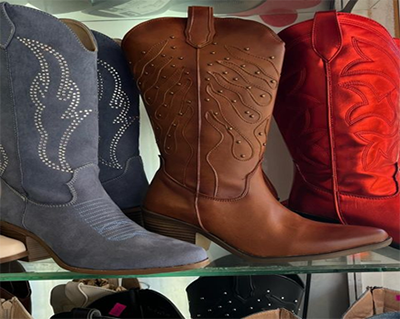
It didn’t take long before the right boots jumped out at her. “The brown ones!” she said. “They’re almost like my old ones that I lost when … you know … when I ran. But these are different. These boots are made for walkin’, not runnin’ away! Can’t you just tell? They will last me a good time and I can go wherever I want in them!”
“That they will,” the counselor said. “They can take you wherever you want to go. Now let’s go get that burger and onion rings!”
# # #
Author’s note: This story is dedicated to the friend who inspired it, and to all the women who are survivors of sexual abuse and remain incarcerated for acting in self-defense. Women are twice as likely as men to be convicted of a crime after claiming self-defense. Many insti-tutions that are meant to protect them fail them repeatedly.
Elayne Clift writes from Brattleboro, Vt. Her short story collection Children of the Chalet: New and Selected Stories won a prize for fiction from Greydon Press in 2015. www.elayne-clift.com
|


