|
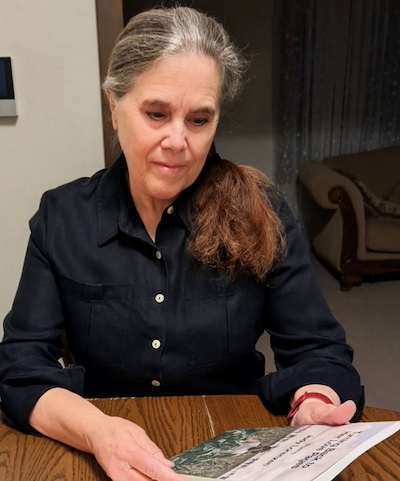
Interview Judy Lorenzen
Judy Lorenzen is a poet, writer, and teaching artist. Her education includes a Doctorate of English, Composition and Rhetoric from the University of Nebraska at Lincoln; an M.A. in Creative Writing from the University of Nebraska at Kearney; a Doctorate of Theology from Andersonville Theological Seminary; a Master of Science in Community Counseling from the University of Nebraska at Kearney and a B.A. in English also from the University of Nebraska at Kearney. Her work has been published widely in literary magazines, anthologies and journals. Her first collection of poems, ‘Turning Back to Her Love Pages’ was published by Kelsay Books in 2025.
------------------------------------------------------------------------------------------------------------------------
Judy, tell us something about your background and how you first became inspired to write poetry.
As a little girl, I spent hours under these wide Nebraska skies playing in the trees on our farm, taking in the beauty and music of nature. My mother loved life; love was the motivation of her life. She was a woman whose faith was alive. She loved poetry and in her grade school years had memorized poems by Neidhardt, Donne, Longfellow, Frost, Blake, Yeats, and many more. She would quote them to my sisters and me like she had written them herself. She also read to us from the Psalms. These creative forces inspired me for the rest of my life. I wrote my first poem in fourth grade, and it was several pages long, a young girl lamenting having to move off the farm.
Describe for us your writing process.
For years my writing process was that I had all of these good ideas, sat down to write them, and ended with a blank page. In my younger years, I waitressed, helped on the farm, and raised two little boys. I had the desire to write but wrote little. In my late twenties I started college, and I realized that every time I had a deadline, I had the essay written ahead of time, no blank pages. I had to have an assignment to write, which translated into classes and degrees. Three years ago, I resigned from teaching English to write. I disciplined myself after a long walk in the morning, to sit down and wait for the words to come. On my walks, nature stirs my thoughts and teaches me lessons; I listen. Basho wrote, “Sitting quietly / doing nothing / Spring comes / the grass grows by itself.” That “grows by itself” is my process now. Some poems just spill right out. Usually, I’ve been thinking on the person or idea for a while, and the owl I saw or the bare trees with stars for leaves in my focus will just bring nature and my thoughts together for the poem. Other times, I sit down and wait and wait and wait.
Your book, ‘Turning Back to Her Love Pages’ is a wonderful testament to your parents. It tells us much about the environment which you and your sisters grew up in. One of the many strengths of your writing is your ability to turn the personal into the universal so that we can all identify to some extent with what you have said. If I may quote from the last lines of ‘Your Signature’, you write:
What is love that it lives on
after death?
What are words
that they are alive
expressing the longings of the heart,
even holding the power
of the universe in them?
I guess the whole genesis and purpose of this book is bound up in these words. Am I right?
You are correct. I wanted to capture a portrait of my mother, so the purpose of this book had to be the power of love, its deep source, and its effects on all those who come in contact with its life-changing force. That love changed my father, and I didn’t even begin to communicate the effect it had and still has on my sisters and me.
Some of my favourite poems from the first section of your book are ‘Marigolds’, ‘The Moon Shining on Clematises’, ‘Their Garden’ and ‘Small Things’. Do you have a favourite poem too or do you treasure all of them equally in your heart?
For every poem I’ve written about my mother, I have an exact memory and picture in my mind of her in that moment that reveals her sweetness, and I realize all over again how blessed I was to have her as my mother. She was also so much fun to laugh with, but I’ve never written those poems. My poems about her are of her love for my father and us girls, her faith, and her wisdom, and I admired and marvelled at the way she loved and forgave. My poems about her make me love her even more if that is possible.
The poems in the second half of your book read very differently from those in the first half. To what extent would you say that this is a reflection of the very different way in which you related to your father as opposed to your mother?
My mother and father were opposites, so the differences in the sections surely contrast the dissimilarities. I hope that readers see that I loved my father with the same love that I loved my mother with, but for years of my life, I was still just a little mad at him. When I learned of his childhood, my heart broke for him. His death gave me 20/20 hindsight—it was a mirror reflecting his great love for my sisters and me and all I failed at in my relationship with him.
What aspect of writing do you find the most challenging?
I still find sitting down, being quiet, and waiting the most challenging aspects of writing because my mind will try very hard to convince me to go ahead and do this or that and then sit back down and write it later.
To what extent do you find consolation in poetry?
I find consolation even in the word poetry! The etymology of the word “poem” comes from the Greek; its first usage was primarily in the New Testament as human beings as divine artistry. We are the poems. That is a consoling thought! Poetry and writing can be healing, cathartic, or joyful, and whatever it is, it is filling great needs in our lives.
You clearly enjoy studying. Out of all your qualifications, was there one that you enjoyed studying for more than the rest and, if so, why?
As I wrote the bio for my book’s author info page, I debated about whether to list my degrees or not, really not wanting to, but I knew in my heart that I had to because my mother delighted in anything and everything my sisters and I did. I taught English for 19 years and mentioned my credentials only once when asked if I had the qualifications to teach the college comp classes. Honestly, I ended up with my education because of my philosophy minor in my undergrad. I can’t say I enjoyed philosophy classes more than any of my other classes, but they certainly had the biggest impact on my life. Those classes like Philosophy of Science or Philosophy of World Literature left me with bigger questions than I already had entering college. I had questions about my severely disabled sister Jill’s life that haunted me like, Why did she get that life, and I didn’t? I studied world religions for 11 years after my Philosophy of Religion class and read as many holy books as I could after that class. I thought the university possessed and dispensed truth through the sciences and theologies, and I was trying to find it. I am grateful for having read and studied the Tanakh, Bible, Apocryphal, Qur’an, Bhagavad Gita, Sutras and scholarly commentaries on the different scriptures and cults. I loved and enjoyed all of my poetry and writing classes. I do want to be a life-long learner and remain teachable.
What are you reading at the moment and who are the writers you most admire?
At this moment, I am reading Orbital Paths by Richard Meyer, and rereading Letters to a Young Madman: A Memoir by Paul Gruchow, Mountains in the Mist by F. W. Boreham, and Songs of a Wounded Heart by Lora Jones (a must read!). I admire so many poets and writers that I hate to mention any, lest I forget one. We have so many gifted poets in this world who have honed their skills in sensory imagery, language, and rhythm to such remarkable levels.
What projects are you working on now and what are your plans for the future?
I am in the process of working with a publisher on my manuscript Seasons of Reverence, a poetic memoir of my life on these beautiful Great Plains. I am teaching myself Greek as I decided I have had enough sitting in a classroom for now, and in the future, I do plan to speak and read Greek fluently, and maybe one day, write poetry in Greek. My father, Jimmie the Greek, would be thrilled.
A Psalm for My Husband After He Was Diagnosed with Heart Failure
I've heard You're close to the broken hearted, Lord,
and my husband's heart is broken—
weak, the cardiologist said,
not able to pump the blood it needs to,
and calcified arteries,
so when the surgeons open up his chest,
to bypass his fossilized veins,
please don't let all of his love
slip out of that incision into the operating room air—
and keep Yourself first place in there.
After all, you’ve been the strength of his heart even now,
and I'll gladly and preferably remain second,
where I belong,
and those who love him, his family, third
and don't let his warmth waver,
that love for others and animals, always welcoming,
and though he’s been a small farmer, Lord,
don't let his generosity dissipate through that cut—
You taught him to be a cheerful giver,
and I marvel sometimes at his open hands.
Help the newly grafted-in veins
from his chest and leg
bypass those injured arteries
that were only trying to fix themselves
but made worse by rushing in to aid in the fight
against the inflammation.
Guard his heart, Lord,
for all his sweetness
flows from it—
there where you've been busy at work,
teaching him to trust You with all of it. |


