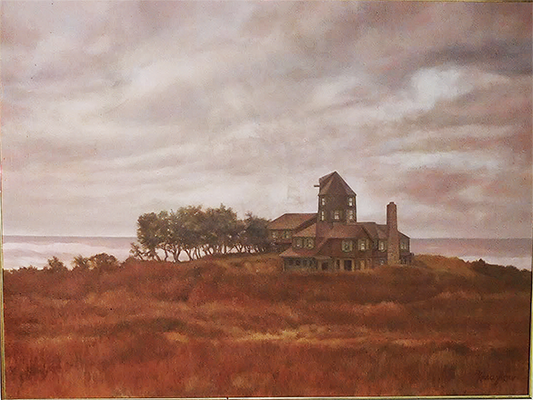
Rheinstein Windmill House Overlooking Ditch Plains in Montauk, NY ~Ben Kasazkow
The Windmill House
by Sara Wadington
My parents built their “pretty little home,” as my mother always called it, in the late 1960s — perched on a hill amid flowing grasses, wild blueberry bushes, and scattered shad trees, just a short walk from the cliff’s edge above the ocean. Back then, the only house standing between us and the sea was the old windmill house.
My father named our property “Tick Top.” He had discovered the land the year I was born, drawn to it as both an artist and a fisherman seeking refuge from the long weeks of city life in New York. They built our house years later, and it would eventually become their retirement home.
Getting there was always an adventure. A long, rutted dirt road wound its way in, churned to deep mud each spring and drifted with snow in winter. Yet every weekend, like clockwork, we came — rain, mud, nor’easter, it didn’t matter. Sometimes the road was simply impassable, and we’d hike in carrying suitcases and bags of groceries. No other homes were visible from any direction. Only the windmill house sat silently at the cliff’s edge, between us and the ocean. That solitary, unobstructed view was what my parents had fallen in love with.
After its owner passed away, the windmill house changed hands to renters who never seemed to stay long. Eventually, it stood vacant more often than not — lonely, still, and to my young eyes, unmistakably haunted.
The cliff was slowly coming for it. Year by year, wind and rain and ocean waves gnawed at the land’s edge, and the house crept closer to the precipice. It had already survived the great New England hurricane of 1938, but erosion is a more patient adversary than any storm.
One warm summer day, long after the house had been abandoned, my mother and I slipped inside. The years of neglect were plain to see. Old wooden floors creaked and groaned beneath our weight as though we were disturbing something that didn’t wish to be disturbed. The air inside felt cold and damp despite the bright afternoon outside, heavy with the smell of salt and decay. Spiders had claimed the ceiling beams, their webs catching the pale light that filtered through salt-crusted windows in a strange, unsettling gray glow. We didn’t linger. The silence felt inhabited — broken only by the wind and the distant crash of waves on the rocks below — and we left feeling like trespassers who had stayed too long.
By then, the windmill house had faded into little more than a dusty shadow of its former self. The cliff’s edge had crept to within twenty feet of its walls. The town had condemned it.
It hadn’t always been this way. Stories circulated of grand garden parties held there in the 1920s — guests in fine attire, the ocean gleaming below, laughter carrying on the summer air. Then came the 1929 stock market crash, which swallowed both fortunes and the man who had built the house.
A few years after the crash, Walter P. McCaffray donated the property to the Catholic Church as a retreat for aging and infirm Jesuit priests. It later passed to Sydney Rheinstein, who guarded his privacy there with fierce determination — and, according to my father, occasionally a rifle. Fishermen who worked the stretch of beach below warned us never to approach the house from the cliff side; we always took the gully to the west instead.
Even as a child, I sensed something still lingering in that place. Walking home from the beach after dark, moving along the cliff too close to the old property, you felt it — a prickling awareness, as if eyes were tracking your steps. A sudden cool draft on a warm summer night. It was foolish, perhaps, but I always walked a little faster past that spot.
Eventually the house was purchased by Peter Beard, who made the remarkable decision to save it. Rather than let the ocean claim it, he had it disassembled section by section and moved to a new property not far away. My parents and I watched the whole operation — a tremendous undertaking. But the story didn’t end there. Shortly after the move was complete, lightning struck the house and burned it to the ground.
I always believed the old man’s spirit resented having his home uprooted. My mother told me I had a vivid imagination — and she was probably right. But some places leave a mark on you that logic can’t quite erase.
The cliff eventually took what remained: the old foundation, the hill it had stood on, all of it swallowed by the sea over the years. Nothing is left now. All things change.
I understand, finally, why he loved it so.
Memories captured in a painting of the old windmill house at Montauk that my father made in the 1960s — seen through the eyes of a child who grew up in its shadow.
|


