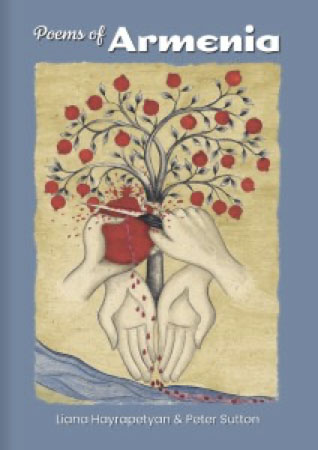
Poems of Armenia
by Liana Hayrapetyan & Peter Sutton
77 poems, 96 pages
Price: £8
ISBN: 978-1-916910294
Publisher: Black Pear Press
To order: www.blackpear.net
Reviewed by Neil Leadbeater
Liana Hayrapetyan is an artist, educator and business professional who has lived in five countries and writes poetry in three languages. In addition to her five other qualifications, she studied film at the University of West London and subsequently taught a Master’s course in Creative Media Start-up. She has taught film entrepreneurship students at the iconic Ealing Studios and currently leads a master’s programme in Finance and Sustainability, with a strong emphasis on creativity as a driver of innovation. Her short films have appeared at festivals and she has organised poetry events in London.
Peter Sutton is a writer, editor, adult educator and translator. He taught English in Armenia during the Soviet period and has remained a friend of the country ever since. In 2014, his modern verse translation of the medieval poem, ‘Piers Plowman’ by William Langland was published in the US. He is the author of two collections of poetry published by Black Pear Press: ‘Elgar Country’ (2022) and ‘A Colourful Age’ (2024).
Modern-day Armenia is a small, landlocked country in the southern Caucasus mountains where it is bounded by Georgia, Azerbaijan, Iran and Turkey. In the helpful introduction we learn that, in the past, it was ten times as large, extending at one time to the Black Sea in the north-east, to the Mediterranean in the south-west, and to Lake Van (Turkey), the upper Tigris and Lake Urmia (Iran) in the south-east, incorporating land now governed by its neighbours. We are also told that in 301 AD Armenia became the first state in the world to adopt Christianity as its official religion and that a century later it acquired its own alphabet. This led to a flourishing of religious commentary and translation, poetry and book illustration.
By any standards, this collection is a substantial body of work, ambitious in scope, authentic in detail and foremost in importance in its portrayal of a country whose history and culture remain largely unknown to the rest of the world. Its civilisation and history go back into the mists of time. The Biblical figure of Noah and mention of Mount Ararat, the latter being an icon of Armenian culture, recur throughout the book as if to remind us of some of the aspects of the country’s ancient past. The book is also grounded in more modern times, reminding us that, in the brutal years 1915 to 1923, the country was almost destroyed in the genocide of its people at the hands of the Ottoman Empire, a fact that went largely unrecognised until as recently as 2023. This lead to a world-wide diaspora of its people.
In this collection, Sutton and Hayrapetyan, two poets with very different voices, combine their creative powers to respond to these events in language that is both moving and powerful while at the same time exercising a remarkable degree of concision and restraint. A vast amount of material is consolidated and imparted in the process that leaves the reader with a deeper understanding, empathy and admiration for the beauty of the country and the resilience of its people.
Sutton’s contribution exhibits a tight control over poetic form, especially in terms of rhyme, but Hayrapetyan’s freer verse forms are equally as powerful in terms of their brevity and emotional response. Sutton’s interpretation of Armenian identity is often viewed through its history and its culture, especially in terms of language and food. His poems are factual and provide the reader with a lot of information in condensed form. Hayrapetyan’s poetry is written more from a spiritual perspective affording, even in the most harrowing of events, a measure of quiet reflection. Each poet’s work is presented side by side but not always in strict alternate patterning. The result is almost like a seamless dialogue which is dictated by the subject matter.
The opening poem, Sutton’s ‘Armen, Ararat and Hayk’ tells us that “Armenia means the land of the Armen, / a tribe of the ancient empire Urartu…” He goes on to say that “Armenians don’t speak of themselves / as Armen but Hay, who are named after Hayk, / a great-great-grandson of grumbling Noah. / The truth is hidden in Ararat’s haze.”
In ‘Prunus armeniaca I’ Sutton references one of the most cultivated species of apricot which happens to be the national fruit of Armenia. Genetic studies have indicated that it originated in Central Asia. In ‘Prunus armeniaca II’ he references the fact that its wood is used for making wood carvings such as the duduk, which is a popular wind instrument in Armenia, also known as the apricot pipe. The colour of the apricot is used on the Armenian flag.
Several poems such as ‘How to Eat a Pomegranate’, ‘Lavash’, ‘Basturma’ ,‘Panir’, ‘Khorovats’ and ‘Sujukh’ are related to fruits and foodstuffs associated with Armenian cuisine:
Sweet sujukh is a string of pearls,
pearly walnuts shelled and softened
and strung on threads
like easy thoughts
or decades of prayers,
scores of prayers,
hardening, relentless scores.
Still on the subject of Armenian culture there are poems specific to the illuminated gospels, Saint Gregory, architecture, music and language as well as poems that concern themselves with commerce and trade between neighbouring nations.
Both poets write with equal force on the genocide. Hayrapetyan’s poems ‘Captured’, ‘Genocide Through the Centuries’ and ‘Modern Genocide, or Who Remembers the Armenians?’ are extremely powerful in their delivery. Hayrapetyan’s shorter poems are equally compelling in terms of their emotional impact and brevity. Here is one example quoted in its entirety:
‘If this was the Last Day to Live’
If this was the last day
I had to live
one thing I’d do
I would rush to you
to say how much I love you.
Hayrapetyan’s poem ‘Peace Negotiations’ exposes the hypocrisy of such gatherings in verses that are both terse and succinct:
I was invited into a room
to contribute an idea or two…
I was placed in a seat of honour and served
like an exotic fruit, an endangered species,
in the room gathered to save the world.
They asked me to express my views.
When I spoke no one seemed to listen…
….
I left the room
already dead.
No one noticed
or cared….
This book is not a comfortable read but it deserves to be read by as wide an audience as possible. It reminds us in the current geopolitical climate that ‘truth is seldom simple, never whole.’
|


