|
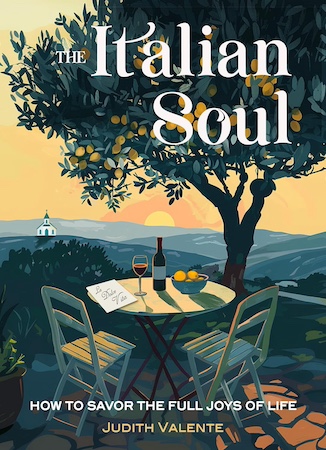
The Italian Soul
How to Savor the Full Joys of Life
by Judith Valente
Format: 5 x 7 ~ Perfect Bound
20 Reflections ~ 20 Illustrations ~192 pages
Price: $16.95
Publisher: Hampton Roads Publishing
ISBN: 9781642970722
Available Now To Pre-Order: Amazon or Barnes&Noble
or BookShop or BAM
And after May 1, at RWW:
Reviewed by Michael Escoubas
True confessions time for a book reviewer. I am a committed “doer.” I make daily lists of items to get done and become “undone” if I haven’t checked the “completed” box(s) by end of day. I occasionally neglect my family by insisting on writing one more poem or adding one more paragraph to a book review. I like a tight schedule and the feeling that the world may fall apart but for my actions!
ENTER STAGE LEFT: The Italian Soul, by Judith Valente. It was her subtitle, How to Savor the Full Joys of Life, which hit me hard upside the head. This remarkable book of life-reflections has taken me hostage.
Pulitzer Prize nominee and former NPR journalist, Judy Valente, freely admits similar shortcomings. However, over time she has become a student of contemplative living. The Italian Soul is a labor of love–love that nurtures a life-long quest to live a full life–a life she found and continues to find in Italy, her ancestral home.
She seeks a more contemplative life,
which means an attitude of the heart that allows one to see the sacred and
poetic in the simple and mundane elements of daily living.
Her native Italy planted the seeds of change. Italy is a nation ensconced in beauty. As if its landscapes, seascapes, skyscapes, history, architecture, food, wines, and fashions are not enough–Italy offers something more–a gentler, more balanced way of life. In Valente’s words, la dolce vita (the sweet life).
The book is set forth in twenty chapters which describe the ancestral traits that shape her life. For Valente, these “traits” amount to art forms. A few examples follow:
Chapter One: The Art of Conversation
Chiacchiera describes a “stream-of-consciousness” chitchat often meant to simply pass the time. In Italy, casual conversations happen all the time. This differs markedly from my constant “face-in-my-phone” way of life. Cocooning is the term Valente uses–we can even order our groceries in bed. Valente quotes from Mother Teresa: “Loneliness,” not heart disease or cancer, is the great American illness. I had to admit that I provide little time to slow down and simply enjoy idle conversation.
Valente offers a brief list of discussion questions at the end of each chapter. Here are the questions following chapter One:
FOR REFLECTION
Do you have a special place to meet with friends and simply chat?
What is that experience like?
What are some effective ways you have cultivated for coping with loneliness and building a community of friends and support?
What are some ways in which you can forge a better sense of community where you live?
Chapter Two: Fare Bella Figura (the Art of Making a Good Impression)
Italian men and women take care with personal grooming and attire. As Valente asserts, “They would never appear in public looking like an unmade bed.” One grants that God looks at the heart not the physical appearance. Valente’s point is about loving others enough to look one’s best. My grandmother never went shopping in downtown Peoria, Illinois, without her makeup, best dress, stockings, and a hat with netting. Without a car, she dressed up to ride the Garden Street bus!
Chapter Four: A Bloody Jesus, a Madonna with Real Hair
This interesting chapter title arrested my attention. It has been noted (tongue-in-cheek) that there are more churches in Italy than grocery stores. Religion is enmeshed within Italian culture. Valente sees reminders of the sacred are everywhere. While institutional religion, in Italy, has waned nationwide over the decades, Italian communities typically retain their patron saints and traditional festivals. All of this tightens and strengthens bonds of faith and family.
Chapter Six: An Ode to Slow
Italy is among the few countries in the industrialized world that has not succumbed to, as Valente puts it, the cult of fast. Italians spend a lot of time cooking, ensuring that only the best ingredients season their foods. Meals take a long time. But people get to know one another; time is spent talking and developing relationships. I’m told that this used to be the case in America. Don’t get me wrong . . . I love my country and the innumerable advantages it offers. However, Valente points are well worth listening to and pondering over.
Chapter 13: Looking for Beauty
Valente compares the beauty of two great American cities: Chicago and Washington, D.C., with small towns in Italy. Both American cities have storied, though much different, beauty signatures. Italy offers the following:
In Italy, you don’t have to look far. Beauty is often at every step. It might be found in the vicoli–the narrow streets of a 12th-century village, or a stone watchtower, an ornate iron gate, a marble arch, or a fresco-covered church. When I am in Abruzzo, I never tire of looking out on the soaring, snow-capped Apennines, or the amber, yellow, and pink pastel-colored houses that line the streets.
Valente’s point references back to slowing down and taking in deep draughts of la dolce vita (the sweet life).
This is Holy leisure. A way of life desired by many, realized by few. It is akin to The Rule of St. Benedict, which Valente describes and applies in chapter 18. Benedict divided the monastic day into measures of time that provided for prayer, study, work, and rest. This included creative “rest” or leisure.
Valente believes that la dolce vita, is within the reach of all, and for its worth–this writer is contemplating changes!
|


