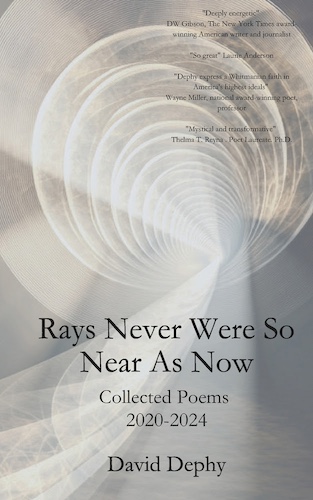
Rays Were Never So Near As Now:
Selected Poems 2020-2024
by David Dephy
45 Poems ~ 87 pages
Price: $10.99
Publisher: Westbrae Literary Group
ISBN #: 979-8-9917199-2-6
To Order: Amazon.com
Reviewed by Michael Escoubas
David Dephy’s remarkable collection is framed by a haunting question: In a world scarred by past wars, how do we navigate the path to peace and understanding? This basic question frames the whole. As one of Dephy’s endorsers says:
The way David’s poetry cuts fantasy with reality and highlights the relief of arriving is beautifully done. It truly pushes the boundaries of art, humanity, and beauty.
(Fevers of the Mind Magazine)
David Dephy knows about war. Exiled from his native Georgia (a country in the Caucasus region on the coast of the Black Sea) in 2017, Dephy, now a U.S. citizen, has lived through war-torn times. His experiences, beautifully captured in this collection, share lessons of encouragement for many in America who are concerned about the future of our own country.
A Word About the Title and Cover
The cover displays a series of light rays which Dephy refers to as “The Three Rays” concept. In a helpful preface he explains the relationship between the different light forms: Convex, Focal, and Central rays. Note the telescopic cover art. As the title implies the Rays range in visual proximity from infinitesimal to large. This brilliant metaphor exudes with the poet’s attitude about life: In a world torn by strife, there is light, there is hope.
David Dephy understands the role of the poet and does not shrink from it. My goal is to demonstrate Dephy’s commitment to his twin themes of light and hope.
A Word About Organic Continuity
The collection is organized into three chapters which mirror the cover: One: The Convex Function of Parallel Ray, Two: The Definition of Focal Ray, and Three: The Structure of Central Ray. While the chapter titles are a bit intimidating, this feeling was mitigated when I focused on the quality of the poems. I’m not a scientist (I was awful at it in school), but when poetry reaches my heart and mind, I feel light’s intensity entering my soul.
Light and Hope Extrapolated
“The Gift” is the first poem I met. In it, I savored hope and light:
In my childhood
I have had an ability
of saying words
in a very different way.
If I was saying “Rose,”
people were feeling
the smell of the rose,
immediately,
by saying “Coffee”
people were feeling
the smell of fresh hot coffee.
I lost that gift when I grew up,
but I found it once again
when I was miserable,
left alone, left for dead.
I said: “Hope,”
and you appeared,
sitting right next to me
in the empty subway station
waiting for a train.
While I may be mistaken, I’m interpreting the “you” in the last stanza as a reference to Dephy’s muse. In my own experience as a poet, I have from time-to-time, felt dead and alone in my writing, until at length, the all-important “you” returned to me.
Throughout the collection, I felt a distinct journey motif. Continuing in chapter one, “Hope” takes centerstage:
Listening to your voice
on the other side of silence
gives me courage
to lose sight and swim there,
your voice is hope trusting the flow.
It calls me now:
we are what we hear,
doubt is deadlier,
but fear cuts
deeper than air,
and I am not moving toward revenge,
I forgive myself my own loneliness.
It’s hard to form.
What I like about journeying with David Dephy is the latitude he gives to individual life applications. We are all different and come to poetry with our own stories. Dephy refrains from arcane pigeonholing. In this regard, I related to the simplicity and beauty of “Before Dawn”:
A stillness broken
before dawn,
in the name of
all that’s hailed,
in the name of
our very present,
in the face of it all–
the remaining past
unclaimed, driven
forth by faith.
Moving into Chapter Two, the poem “Fog,” signals a change in tone. “Fog lies low over the land. / Rain drives soft across the fields. / Comatose landscape.” As the poem continues Dephy creates a seeming antithesis to hope. “There is nothing immediate we can hope for, / now we have nothing to do but breathe, / until something better shows up.” This is a poem not to miss, because Dephy uses his fog metaphor to create an impactful ending that spoke to my heart.
Throughout chapters two and three, Dephy creates then breaks tensions. Darkness imposes itself on life. Then, after setting the scene locking it in as one thing, surprise occurs accenting life and hope, often with a touch of irony. These poems strike me personally as linking me to life, my life, my burdens, my unique experiences in fog. But Dephy doesn’t allow me to stay there. In “The Sky Is Clear Tonight,” the poet avers:
This endless journey
keeps me turning back
to something forgotten,
to something misplaced,
keeps me turning back
toward you,
and the clouds above you
form as the moon rises,
and we still try to give them
a sense of purpose.
Ah yes, a sense of purpose. Without a doubt, David Dephy has traversed a long and arduous journey, baptized by poetry and sanctified by a muse who continues to work in and through his spirit. This collection is a must have for all who aspire to walk in Light and Hope.
|


