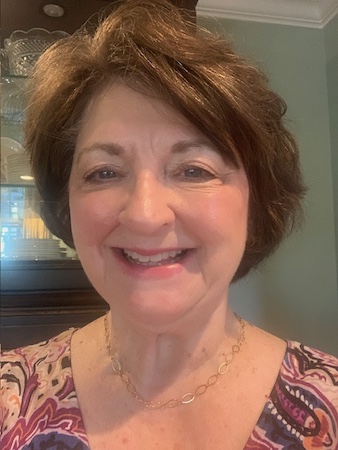
Interview with Annette Sisson
Annette Sisson, Professor of English at Belmont University, is the author of ‘Small Fish in High Branches’, (Glass Lyre Press, 2022) and ‘Winter Sharp with Apples’ (Terrapin Books, 2024). Her chapbook ‘A Casting Off’ appeared in 2019 (Finishing Line Press), and her third full-length book, ‘Rhizomes and Bones’, was recently the runner-up in the Cider Press Book Award contest..
Sisson’s poems have been published in Valparaiso Poetry Review, Birmingham Poetry Review, Rust & Moth, Lascaux Review, and elsewhere. In addition to winning The Porch Writers Collective's 2019 Poetry Prize, her poems have received multiple nominations for The Pushcart Prize and Best of the Net. She was named a BOAAT Writing Fellow (2020) and a Mark Strand Scholar for the Sewanee Writers’ Conference (2021). She resides with her partner and soft-coated wheaten terrier in Nashville, Tennessee.
----------------------------------------------------------------------------------------------------------------
After completing your M.A. and Ph.D. degrees at Indiana University, I note that you have spent your entire career in the English Department at Belmont University. During that time you must have seen a lot of changes in the way English has been taught as well as some changes in the curriculum. How would you sum up your time there?
Belmont University has grown from 1600 students when I arrived in 1989 to almost 10,000 students currently, so the university and campus are practically unrecognizable from my original impression. As you might expect, the English Department is also much larger, but not proportionally so. Our tenured and tenure-track faculty are about double the number in the original department I joined.
I would say that the teaching of English is less focused on bodies of knowledge and “coverage” of that knowledge and more focused on engaging students in transformational learning as readers and writers. We haven’t moved from knowledge-based education to skills-based education so much as we simply recognize the importance of students’ whole selves—minds, bodies, psyches, spirits, histories, social and cultural situatedness—within their experience of reading literature and their writing process. We immerse our students in knowledge, skills, and experience, but we realize that they will never master all the facets of English while in college, so we try to fuel their curiosity and give them tools and experiences that will prepare them to continue to develop as life-long learners after they graduate and become self-directed in their pursuit of further education.
What made you decide to specialise in Victorian British Literature and who would you say are your favourite authors from that genre?
When I started my Master of Arts degree at Indiana University, I knew I would specialize in British literature, but was equally attracted to Renaissance and Victorian literature, and to some extent also Medieval. Indiana University is well-known for Victorian. This department publishes the pre-eminent journal in the field, ‘Victorian Studies’. I took several Renaissance and Medieval courses, but by the time I was in my second year of grad school, I was leaning hard toward specializing in Victorian literature. The faculty were so strong and dynamic, and the possibility of working on the journal, which I was able to do as Book Review Editor, was so compelling that the internal debate was decided.
My favourite Victorian authors are George Eliot (aka Mary Ann Evans) and Thomas Hardy, though there are many other contenders. My interest in 19th-century England honestly spans Jane Austen and the Romantic poets through Modernism, and I am particularly drawn to how Victorian culture transformed into World War I culture and then early/high Modernism.
One aspect of your teaching has been to lead study trips in England. Which places have you visited and how have they contributed to your students’ understanding of the works that they have been required to study?
My study abroad teaching has happened exclusively in England, typically based in London, though in Spring 2022 I was able to live and teach for a semester, with a group of Honors students, at Harlaxton Manor in Lincolnshire. Most of my London-based study abroad trips have also involved a four-day stay in Edinburgh, Scotland. This is transformative education at its best. We always read works that have some connection to the places we visit, and the assignments often call for students to explore and research those places.
Study Abroad makes an enormous difference. I can’t tell you how many students who have studied abroad decide to go back—to extend their travel, to go to grad school, or to share the experience with family and friends. But also the students’ understandings of the literature we read is no longer academic; it’s visceral!
I note that you take a keen interest in theatre. Apart from Shakespeare, do you have any favourite playwrights whose works you turn to again and again? Have you ever thought about writing a play yourself?
As a Victorianist I’ve taught George Bernard Shaw’s and Oscar Wilde’s plays fairly often. But I’ve spent the most time with 20th-century and contemporary American playwrights because for many years I taught “Literature and the Stage,” which was paired with “The Theater Experience” in the theatre program at Belmont. My colleague and I taught these “linked courses” more than two dozen times (the two courses had the same students in both classes and many points of connectivity, including two major “common projects”). So we read Arthur Miller, Thornton Wilder, and Tennessee Williams, as well as Lorraine Hansberry, Tom Stoppard, and Sam Shepard. We explored other playwrights, too, such as Lee Blessing, John Cariani, Lauren Gunderson, Moisés Kaufman, Lynn Nottage, John Patrick Shanley, and others. I was on the Board of the Nashville Children’s Theater for nine years, so I also appreciate theatre for the young and very young.
As for writing plays, I’ve never attempted it. I’ll admit that I’ve thought about it, fairly recently in fact, but so far I haven’t given it a go.
Like me, you tend to seek joy in nature. Would you say that most of your inspiration for writing comes from the natural world?
The short answer is YES. Maybe it’s all the Romantic poetry I’ve studied and taught; maybe it’s because I grew up in a rural setting and spent time alone exploring the woods behind our house. I’m not sure, but nature compels me and my writing probably more than any other influence, though a very close second would be my family—especially my mother and father, who have passed on, occasionally my siblings, and definitely my children, grandchildren, and partner. Even in poems inspired by a family member, though, nature shows up. It’s the language of my poetry, the way I grapple with ideas, the way I try to convey those ideas. It’s rare that I write a poem that doesn’t include nature imagery and nature metaphors.
Apart from the natural world, what other subjects do you write about?
Sometimes ideas, questions, or even feelings. Or issues I’ve read about or items that were reported in the news. Mostly, though, my poems address family relationships and nature. Oh, and death. Sometimes I think all my poems are about death. That’s not true, but death seems always to lurk beneath the surface of my work.
What part does your faith play in your writing?
Beside the fact that trying to become a writer is an enormous act of faith, I do think it propels my writing significantly, but not perhaps in expected ways. I am interested in spiritual questions, but to me they’re not really separate from my interest in space, or physics, or biology. Or even history and culture. The question for me is, what does it mean to have life, what does it mean for that life to end, what meaning might that life have, and how does that life continue to resonate—even if only in occasional glimmers and ripples? I like to think that our lives transcend death even as they are subject to and conditioned by it. I suppose I believe most of all in mystery—in the mystery of life and death and the wholeness of all of life, even the parts we don’t see or can’t comprehend. And when I say “the wholeness of life,” I mean all of life that’s existed or ever will exist—in the present, future, and past.
Do you try to write everyday or just when you feel inspired to do so? Describe for us your writing process.
I try to do something in my poetry life every day, or most every day (some days, life doesn’t allow it.)—either drafting, revising, working on a book manuscript, submitting poems, checking on submissions, updating files, participating in a writing group, attending a reading, reading others’ poetry, etc. All these things count.
I’m in quite a few writing groups, which helps me keep writing new work. Honestly, I don’t love the generation process as much as I do the revision process. When I generate a poem, it’s just a handwritten blob on the page, unlineated, often barely legible due to all the scratching out and rewriting. Then I take this mess to my laptop and type it up, usually four stresses per line (it’s my default, though I often change the lines later). From then on, I work at the keyboard. My revision process is focused and intense. I work hard until I get it to a point where I feel like it’s “finished for now.” But that’s just phase one. I come back to the poem, give it another go, hard, and then I take it to workshops and gather feedback from other poets. And then, I revise it, again and again, until it “hums,” until I feel it’s really finished. And then I come back to it later, after weeks or months have passed. At that point I might see things that need to change that I couldn’t see before. Honestly, the revision process is never finished, but the tweaks lessen over time.
What reading, other than poetry, is important to your work as a poet, and why?
I teach all kinds of literature—fiction, essays, creative non-fiction, and drama, as well as poetry. Some of it is historical, some contemporary. I am influenced by the language in everything I read and teach, from Victorian novels—particularly the Brontës, George Eliot, and Thomas Hardy—to Margaret Atwood, Barbara Kingsolver, Tim O’Brien, Ian McEwan, Kazuo Ishiguro, Toni Morrison, Wendell Berry, Anthony Doerr, Ann Patchett, and many others. Also, my study of 19th- and 20th-century British poetry conditions my own writing as well.
Which projects are you involved in at the moment and what are your plans for the future?
I finished my third full-length book manuscript last fall and then added a few more poems as I started submitting it again in January. I don’t feel like I have much more tinkering left to do with that project, so now I’m focused on generating new poems. Eventually I’ll begin to think about the fourth book manuscript, but it’s too soon at this point.
Because I am retiring in May, after 37 years of teaching, and because now that I’m in my final semester I’m experiencing some separation anxiety and worry about my post-retirement life, I’ve been writing a series of poems that I’ve tentatively titled “Preparatory Studies, Retirement.” I’m trying to use poetry as a way of looking the demons that frighten me straight in the eye!
We close this interview with a poem written in earlier years:
Matriliny
Home from the hospital nursery, your brother
wobbled and thrashed. First colt in the pasture.
I wondered how high he could leap, how
wild he’d toss his mane. I approached him
gingerly, wary of hooves and knobby knees,
warier still I’d jolt him. When you appeared,
my arms formed a crook, a hollow the depth
of your head. You were my fawn, yeasty
and sweet. We’d always known each other,
even before your seed had opened. You’re
the girl my mother could have been. She roams
the woods with you, lives inside your stride,
its confident measure. I picture your brother
cantering in afternoon heat. He has shaken off
my faltering lead, grazes on clover, smooths
a path in alfalfa. I catch his eye, his soft nicker
in the distance. But you, my fawn, are the elegant
deer in the forest of my tangled memory—
my mother’s body, her phrasing and voice.
You prod among brambles; she squeezes
through gaps. Trunk and sprig of my limb,
the pair of you merge, spin through time,
before, and after, ripple in my chest.
This poem was first published in Cider Press review (August, 2025) and is reproduced with the permission on the author. |


