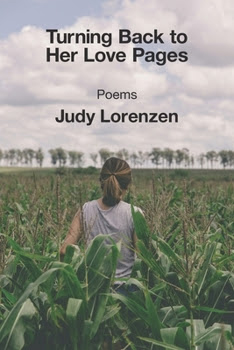
Turning Back to Her Love Pages
Poems, by Judy Lorenzen
46 Poems ~ 100 pages
Price: $20.00
Cover Design: Shay Culligan
Publisher: Kelsay Books
ISBN : 978-1- 63980-757-4
To Order: Amazon.com or Kelsaybooks.com
Reviewed by Michael Escoubas
If you are one who, like this reviewer, laments the state of the world: its violence, its vitriolic rhetoric, the seeming absence of good manners, and forbearance. In short: lack of love and respect. Judy Lorenzen’s Turning Back to Her Love Pages will change your life. In the words of Kathryn Kurz, Assistant Professor of Education at York University . . . “Judy’s special gift is to show us that love is a choice; love is powerful, and love is the most excellent way.” Turning Back is lovingly dedicated to the author’s parents, who gave Judy the seeds of their lives, not knowing that what they gave would blossom into poetry and bloom forever.
The collection is divided into four sections: I. Second Chances, II. Portraits of Mother, III. Portraits of Father, and IV. Love Lives On. Each section adds to and builds upon the former, resulting in a fully orbed picture that gave birth to the whole.
The title poem “Turning Back to Her Love Pages” (Second Chances) provides helpful background about how her parents met. Their “love story began in 1949, / when they married after six weeks of meeting, / her, a high school graduate, waiting tables.” Soon their first child was born. Six more daughters graced their lives over the years. Jill was severely disabled. As with most marriages there were trials. Here is an especially poignant expression:
If love could die from troubles,
the heart-framed mirrors of their hearts for each other
would have shattered.
But she loved him with a rare love that always
reflected back a beautiful image of the one it was set on.
Amid their troubles and sufferings, life’s most important question takes center stage:
And what is love anyway?
A commitment to stay–no matter what?
One poem builds upon the next. Like an artist’s brush strokes, Lorenzen’s canvas gradually fills with colors, landscapes, and loving portraits that shed fresh light upon the poet’s core question, what is love anyway?
Wisdom and irony play heavy in “What Mother Taught Me.“ The poet’s family is moving from her childhood home in Malcolm, Nebraska. Judy’s heart is heavy. She weeps at the thought of leaving “a hundred thousand points of light in the soft violet sky.” Her mother inquires:
“Look at my trees I love,
smell the fragrance of these green grasses,
listen to the crickets’ last song for me,
and look, look at those stars–
I’m losing everything!”
The poem rounds out with deep-founded wisdom that justifies the price of the book. The irony noted above will resonate. Don’t miss this one!
Moving into Section III “Portraits of Father,” I was reminded of my own father. “What the Depression Taught My Father,” placed me with my own:
be grateful for the job you have–
never assume you’ll always have it
never assume you will have a home tomorrow
be grateful if you have a roof over your head
shut the lights off when you leave the room
know that all work is honorable
get rid of any pride you have
The poem, thirty-seven pregnant lines of how to live and what to do, surely must have instilled a sense of awe and a little dread within the psyche of a young girl. “What Brought Him Back” signals that all was not well in the household. Consisting entirely of questions … here’s a sample:
Was it the love of a woman
who would not stop believing in him?
Was it a vow he had spoken and committed to
years earlier?
Was it the moon watching him, night after night,
as he was making his decision?
My sense, from reading between the poet’s lines, is that good somehow finds its way to the surface. All the trouble, all the suffering, somehow gets reconciled. “Fog” is that kind of reconciling poem. It is a poem that many finally write upon their hearts, if not on the page:
I’d give anything
to see my father again,
a man whose love
I rejected most of my life
when the fog of resentment obscured my perspective–
then I took his love for granted
like he owed it to me.
But death and memory offer
the sorrows of hindsight,
the blessing of clear vision.
Now I see everything,
and what I see
is all I failed at,
and what I remember
is goodness,
and the only thing I feel
is mountains of love.
Ah, yes … mountains of love … would that all of us give our parents credit for doing the best they could with what they were given. Thank you, Judy Lorenzen.
|


