"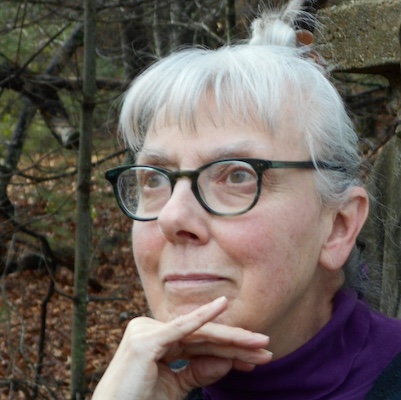 Interview with MFrostDelaney Maryann, who writes under the pen name of ‘MFrostDelaney’, is a frequent contributor to Quill & Parchment and many of our readers will be familiar with her work. In addition to being our Featured Poet in October 2022, she has also been a regular contributor to our ekphrastic prompts as well as to our main poetry section. Her work has been published in The Powow River Poets Anthology II (Able Muse Press, 2021) and Extreme Sonnets II (Rhizome Press, 2022). She is a member of the Powow River Poets in Newburyport, MA. An accountant by profession, (”bean counter by trade”), she resides in New England.
--------------------------------------------------------------------------------------------------------------------
Maryann, please tell us a little bit about yourself and how you first became interested in writing. When I was in junior or senior high school, I had an assignment to write a story. I left it until the night before it was due. Then I sat and watched my mother wash dishes. Soon the dishes came to life in my head and their story came. I liked it. So did my teacher. But, being young and busy with sowing oats, then starting a family, I did not revisit writing until I was in middle-age. Then poems came.
Who are the poets who have most inspired you the most over the years?
Without a doubt, Rhina Espaillat.
Are there any common themes to your writing?
Nature. Family. Personal experience.
Paintings and photographs would appear to be an especial source of inspiration for your writing. Do you have any favourite artists or photographers whose work you particularly admire?
No. How do you go about writing an ekphrastic poem? Do you, for example, attempt in your imagination to inhabit the mind of the artist, provide a close reading of the work or let your imagination take free reign in interpreting what you see before you?
I sit with the image and let it speak to the muse inside me.
Tell us a little bit about your writing process. Do you, for example, place a lot of emphasis on revision?
I rarely rewrite. The truth is, when I have completed a poem, I tend to divorce it.
Do you have a special place where you like to write and do you try to write something every day?
I primarily write on Sunday mornings while sitting in my comfy chair.
You are a member of the Powow River Poets. To what extent has this group of primarily New England poets influenced you in your writing?
I learn a lot from listening to and commenting on their poems. The real value in a writers’ workshop is not in focussing on the comments given on one’s own poem – although that is important and helpful. The greatest benefit is in focusing on other people’s poems and what is said about them.
One of my favourite poems of yours is the one called ‘October Contentment’. You pack a lot of detail into it in the space of 14 lines. It speaks of the beauty of the fall in New England and has a positive ring to it. In another of your pieces called ‘The Poem’ you make the statement “love is only hate / turned inside out”. How important is it to you to record the daily routine of living and to cast it, where at all possible, in a positive light?
Not important. What is important is listening to the muse. If I sit to write about something I want to write, that is not as important as what the muse says. I can’t write well what I want to write. I must write what the muse inside guides me to write.
What are you working on at the moment and what are your plans for the future?
I am pulling together poems requested for Extreme Formal Poems II to be published by Rhizome Press. I will be submitting primarily heroic sonnets, a form that many strict formalist poets reject. But I believe the heroic sonnet is far past due for recognition. I have just submitted poems for the Powow River Poets Anthology III. My plans? To continue writing poetry. The poem is the most important.
----------------------------------------------------------------------------------------------------------------
A Chance Encounter –
I saw him at the market yesterday
just after bread, before the produce aisle,
a corner turned, then quickly turned away.
Can I escape? Or should I simply smile?
Too late. He saw me too. I felt his stare.
So we exchanged a long and awkward look.
Then suddenly, my old emotions bare,
my guard escaped.
A smile. That’s all it took.
We uttered pleasantries, the decades gone
as if the day we met came back to us,
his dark eyes locked on mine, and mine upon
his Fogerty mustache, his hair a muss.
Of all the things he could have said, what came —
the night we slept on Hampton Beach, our bed,
the bliss.
He had no need to point the blame
why we broke up. That all was gone. Instead . . .
Remember how we woke to gulls in flight?
Oh yes, they had the day. But not our night.
(This poem was first published in Quill and Parchment in February 2024).
|


