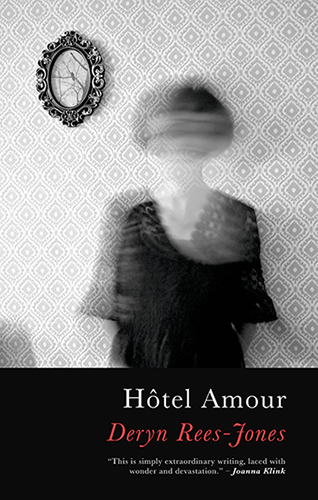
Hôtel Amour
Deryn Rees-Jones
A sequence in three sections, 111 pages
Price: £12.99
ISBN: 978-1-781727843
Publisher: Seren
To order: www.serenbooks.com
Reviewed by Neil Leadbeater
Anglo-Welsh poet, editor and critic Deryn Rees-Jones was named as one of the Next Generation Poets following her debut collection, The Memory Tray (Seren,1994) which was shortlisted for the Forward Prize for Best First Collection. She has written extensively about twentieth century women’s poetry, and her landmark anthology Modern Women Poets was published in tandem with her critical work Consorting with Angels (Bloodaxe, 2025). She has received various awards for her own poetry, including an Eric Gregory and Cholmondeley award. She is editor of the Pavilion Poetry list and is a Professor of Poetry at the University of Liverpool.
As a sequel to Erato, which was shortlisted for the T. S. Eliot Prize, this latest book sees Rees-Jones returning to her ongoing preoccupations with the complexities of memory, desire and the body and the place of poetry in the contemporary world. Philosophical questions posed by the writer on subjects such as the nature of love add to the book’s universal appeal.
In common with many works of the imagination, this book is rooted in time and place. There are allusions to wars and other global conflicts and there are also references to the pandemic. In the real world, the Hôtel Amour may be found in the Rue de Navarin, Paris. It is described by Trip Advisor as a very nicely appointed boutique hotel in a fantastic 9th arrondissement location halfway between Opera Garnier and Sacré Cœur. As noted in the opening pages of the book, it really does have a pink neon sign on its facade with the words AMOUR advertising its presence.
In many ways this book-length poem reads like a novel. Particular attention has been paid to the way in which the text is presented on the page. This applies to line breaks and the amount of space that has been left blank between one paragraph and the next. In some ways this serves as another form of punctuation, signalling to the reader how much time should be taken to pause between one thought and the next. Rees-Jones’s expansive lyrical lines are presented in a mixture of prose and poetry divided into three distinct sections: a sequence of 24 sonnets flanked by sections titled ‘The Hotel’ and ‘The Garden.’ It opens with a woman checking into a hotel in Paris and ends with a departure set in an airport building. Between the entrance and the exit we are given a fragmented narrative, often in multiple layers, where past and present run into each other in a seamless dreamlike episode on subjects as wide ranging as street life in a Parisian neighbourhood, a love affair relived in the memory and a virus ravaging a woman’s body. In several poems, Rees-Jones makes use of a mirror as a device for introspection to good effect.
Along the way, variously named in French and English, we encounter many birds. There is even one present in Fidan Nazimqizi’s photograph on the cover which, interestingly enough, is the only object that is seen in focus. This may be interpreted as being a symbol of the resilience of nature, something to concentrate the mind on, during a period of uncertainty and fear in the wake of the pandemic.
Reading this collection I was struck by many beautiful turns of phrase which startle with their abrupt unexpectedness: ‘Suddenly a lime green bike propped up beside the métro sign was nothing short of beautiful’
Her carefully curated imagery stays in the mind long after the initial reading:
The sun hung low. Before she made her way back home she saw two little girls playing by the métro vent, cheerfully daring each other to throw empty paper coffee cups into the air.
She watched the small vessels rise and rise,
as the subterranean heat blew up into the boulevards.
As mentioned earlier, much of the book is multi-layered with imagery. For example, in the final section titled ‘The Garden’ there is the overgrown garden outside the hotel window, then the Jardin des Plantes and then Cranach’s Renaissance depiction of the Garden of Eden. These interlinked references add to the richness of the text sparking off further images in the mind of the reader.
Rees-Jones has a precise poetical feel for language. It speaks to us through lines such as ‘I like the way the o leans tight into the e in cœur’ (Sonnet I) and the playful mention of ‘Eros. Roses. Roars’ (Sonnet XVI). Literary references to Spenser, Donne, Shakespeare and Wordsworth also serve to enrich the text.
A sense of vulnerability often surfaces in her work: ‘Her own history sat documented in fragments, completely adrift.’ There are many instances where opposites, some of which complement each other, are brought together: ‘self and other, left and right, Laurel and Hardy, Ginger and Fred, up and down, old and young, poetry and prose, X and Y, love and hate, life and death.’ Sometimes these opposites strengthen one another and, by their very opposition, define each other. At other times they hint at uncertain outcomes. The space in the text between what is LOST and what is FOUND is surely occupied by memory. In reality, there is much that we do not recall in life: ‘Some afternoons, she surfed the net, aware that she was looking for something she could not find.’ As stated later in Sonnet XII, she writes ‘We live in the gaps.’ Memory is everything.
A phrase and a word (both of which I had to look up) appear to be loosely related in this book, The phrase is ‘Paris Syndrome’ and the word is ‘cherophobia’. The former is used to refer to a sense of extreme disappointment experienced by some individuals when visiting Paris who feel that the city does not live up to its expectations. The latter is a fear of happiness, an irrational aversion to being happy or engaging in activities that are generally considered to be enjoyable. Any feelings in that direction are quickly dispelled by scenes of restoration encapsulated in a series of interlinked images starting with the woman making a recovery from the virus, followed by the repair of a broken window in the hotel, the restoration of Notre Dame Cathedral after the fire and the renovation of the Hôtel de Dieu. A voice finds itself and lifts itself into song.
In Sonnet XVIII Rees-Jones writes ‘What I like best in a poet / or rather the poem, by which I mean – of course – the poet, is an ability to lose the self.’ This book is a wonderful absorbing read – one that you can lose yourself in quite easily. Highly recommended.
This review was first published in Write Out Loud (UK) and is reprinted with kind permission. |


