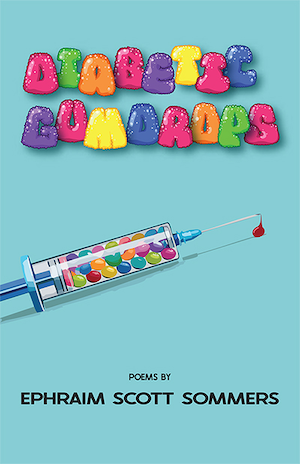
Diabetic Gumdrops: Poems
by Ephraim Scott Sommers
24 Poems ~ 88 pages
Price: $15.00 (+ shipping)
Publisher: Main Street Rag Enterprises LLC
ISBN: 979-8-951438-02-7
To Order: mainstreetragbookstore.com
Reviewed by Michael Escoubas
From the outset of my review preparations I felt an affinity with Diabetic Gumdrops: Poems by Ephraim Scott Sommers. One of my sons was diagnosed with Type I diabetes at age twenty. He is now forty-seven and has lived heroically as Type I all these years.
Sommers sets the stage with a line from Albert Camus’ The Myth of Sisyphus: “One must imagine Sisyphus happy.” I get the impression that Sommers is drawing from Camus’ assertion that even though life is hard to figure out, often indifferent to our suffering, man can/must transcend his circumstances, creating meaning by willing his own destiny. Indeed, Sisyphus, the Greek mythical figure condemned to eternally pushing a boulder uphill, seems an appropriate metaphor. Just as Camus insists that “One must imagine Sisyphus happy,” Sommers writes his poems in happy revolt. His childlike playfulness with cover art caught my attention. The syringe is packed with “gumdrops,” a revolt against the boulder that would paint a smile on the lips of Camus himself.
Sommers has chosen the poetic form of “Ode” through which to express his “gumdrops.” A few lines of definition and application: An ode is a lyric poem that expresses admiration, reverence, or deep reflection. While writing in accessible language, Sommers stays faithful to the ode form as “elevated” “lyrical” language that conveys the pathos that resides in his heart. Even his titles would comprise poetry should one align them so:
Ode to All the Pillaging We Have Withstood
To Telling My Best Friend Two Weeks After Diagnosis Day
Ode to the First Night the Too-low Happened
To the Oldest Music Lesson There Ever Was
To the Third Night the Too-low Happened, to the Long Film,
Still in Production
To Broccoli
You get the idea … just as Sommers’ titles tell a story and offer readers a framework, his poems sing with music-like rhythm and performative drama. If these poems were read in a “slam” contest they would win.
I want to pick up on [Ode] “To Broccoli.” For diabetics a good diet is essential. And broccoli, is among the best examples of diabetic “must-haves.” Sommers has fun with this ever-green veggie:
the most splendor goes first to its trunk
like a bonsai’s map of the past
like us as children in incredible hulk pajamas
or hand-me-down lime night gowns
exploding open our morning arms
… … …
who touched a cut of green before it made its way into our mouths
and into our cells and biceps and became whatever mushy and magic stuff
the valves in our hearts are made of
how the history of broccoli suddenly becomes the history of us
taller and taller our father’s carved marks
of dates and names on the white frames
… … …
our parents wouldn’t let us leave the table
until we’d chewed through the whole forest of tiny trees on our plate
with what ease we could fire down the peas and carrots
on any given meatloaf night
like any stray berry we’d find on the ground in the pantry
but not the broccoli
Throughout this poem and many others, the poet writes a little “tongue-in-cheek” while conveying a serious message. Nature’s fundamental provisions are to be known and appreciated. For diabetics life depends on good dietary choices.
“Ode to How Difficult It Must Be for Doctors to Deliver Bad News” explores, at length, the pathos the poet experienced when diagnosed. In graphic language, Sommers delivers the full “load” of words most people are thinking but seldom utter.
On its surface [Ode] “To Saying Thanksgiving Grace Without Dark Meat,” is about the traditional banquet on a sacred day of family gathering. But looking deeper, the poet envisions the much grander banquet of meaningful living:
Forty-two Thanksgivings have taught me that all of life is an art piece,
a decoration of time,
and we must break
something to get the world to look just how we want it. This Thursday,
we know, has never been
about Turkey, and if you,
who is listening to this prayer, are a God, I’d ask you
what you’ve broken
in your own life
It seems appropriate to end with something of an opening, a non-conclusion, food for thought: What about this banquet we call life? What about this poet’s diabetic gumdrops? If diabetes is part of your life, Ephraim Scott Sommers’ seminal collection offers unique and personal perspectives. Why not imagine Sisyphus happy?
|


