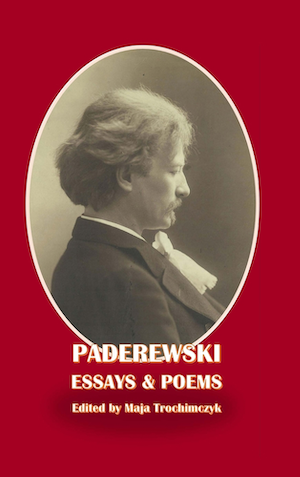
Paderewski: Essays & Poems
Edited by Maja Trochimczyk
51 Poems ~ 4 Essays ~ Chronological Life Timeline ~ 255 pages
Price: $32.00
Publisher: Moonrise Press
ISBN: 978-1-945938-88-7
To Order: Amazon.com
Reviewed by Michael Escoubas
In her monumental work, Paderewski: Essays & Poems, Editor Maja Trochimczyk brings the world front and center with Ignacy Jan Paderewski (1860-1941). Over the course of eighty-one years of life, Paderewski’s reputation entailed: piano virtuoso, composer, divine messenger, essayist, Polish patriot, statesman, philanthropist, and spiritual master. It is Trochimczyk’s goal to ensure that the world dare not forget Paderewski’s contributions to life, art, music, and social and spiritual well-being. His stellar life continues to be impactful to this day.
Trochimczyk has structured the book into three parts: Part I. Paderewski Poems, Part II. Paderewski Essays, and Part III. About Paderewski. Part III includes five interesting components. These include: Calendar of Life, Writings, Compositions, Archived Materials, and a Selected Bibliography.
This review will focus primarily on the man himself. Trochimczyk’s interesting and detailed introduction portrays her subject as an early 20th century version of a rock star. Following his formative studies in music in Warsaw, Berlin, and Vienna, he and his legendary Steinway became famous in concert venues the world over, especially in America. Paderewski was idolized by young women who coveted locks of his hair as keepsakes for their scrapbooks. Concert sales made the virtuoso a wealthy man. Trochimczyk provides a listing from the New Times of popular musicians and artists who performed in that city. To name but a few: Igor Stravinsky, Sergei Rachmaniknoff, Shirley Temple, and Judy Garland, each had 10,000 mentions. Paderewski garnered 7,820 mentions in the NY Times. This table is a fascinating commentary on American culture during that period.
While Paderewski was not a poet, his life and achievements elucidated a rich corpus of poetry about him. Juliet C. Colin (1931) captures his widely held veneration:
The Maestro
–To Paderewski
From the thunder of the tempest
To the sky lark in its bliss,
From the depths of human agony
To the touch of Cupid’s kiss,
We will follow him enraptured
Where Elysian billows swell,
That burst in glorious anthems
Where the hosts of Eden dwell.
Ablaze in all his glory,
Imperial with his peers,
Evolving with the ages
And growing with the years,
Superb, this uncrowned sovereign
Attuned to God and man
Comes heralding to mortal ears
The strains from spirit-land.
For reader context, Trochimczyk provides footnotes which identify the poets whose tribute poems appear in the book. The writers all bear a special relationship with Paderewski but would not otherwise be familiar to most readers.
William Kimberly Palmer’s “Immortal” (1928) exemplifies yet another dimension of Pad-erewski’s stellar reputation:
This Great Genius – Soul of Poland
Did Ably Lead his Race
Its armed opponent to front
With indominable face.
A wonderful composer,
A superb artist of renown,
He laid his fortune in the Scales
To pull the tyrants down.
Premiered a while – he founded
A Nation that will last
And though by foes surrounded
Poland hath visions vast.
A people none can overthrow
Since God hath brought them through the woe.
Immortal Paderewski,
You have given your Land a Place
Among the Leading Nations
That time will not efface.
And the Centuries will acclaim you
As a Soul of supreme Grace.
While I found the tribute poems almost “excessive” in their praise, I paused in amazement at how much Paderewski was respected and admired. I searched in vain for any overt criticism of his life.
Trochimczyk’s essays are masterpieces of research and erudite scholarship. Her essay entitled “Paderewski in Poetry: Master of Harmonies or Poland’s Savior,” explores Paderewski’s dual triumph as musician and patriot. Trochimczyk explores Paderewski’s role in securing Poland’s independence. For over 120 years Poland was subjugated by Russia, Prussia, and Austria. Paderewski’s compositions paired with his patriotic actions and writings forever endeared him to the Polish people. This poem by editor and writer Henryk Merzback, recited at a reception honoring him shows the high regard in which he was held:
Sail, o young master, on this ocean
Of storms, passions, delights and glory …
Play for us and let the nation resurrect
if only for a moment, believing in ideals …
Your music unites us with heaven and with our country,
So please accept our heartfelt worship.
The world will give you fame, we give our heart–
to you, new Chopin.
Accompanying this poem the author includes a fascinating late 19th century image of a postcard depicting Paderewski playing the piano. As he plays, a supernatural light emanates from the instrument. In the background ghosts of Polish kings appear, giving the whole scene a kind of divine immanence.

Such was the emotional and spiritual grandeur of the man. His music was considered providential in Poland’s national life.
Trochimczyk’s essays range in length from 36, 47, 26, and 20 pages respectively. Essay #2 entitled “Paderewski’s Image and His Female Audience,” explores her subject as “an astoundingly beautiful, golden-haired young archangel.“ Trochimczyk provides an exquisite compilation of the people, (particularly women) places, and circumstances that led to this unique perception.
Essay #3 entitled “A Paderewski Album from Brighton, England, 1890-1914” is a fascinating collection of press clippings, concert tickets, dedications, handwritten notes of veneration, and appreciation. All of which contribute to a full-orbed portrait of Maestro Ignacy Jan Paderewski.
In the interest of the aforementioned “full-orbed” portrait, here is a brief description entitled “How Paderewski Played”:
A lone spotlight highlighted the golden hair of the pianist at the center of the stage; the concert hall was shrouded in darkness and emptied of sensory stimuli other than the sound of Paderewski’s piano, heard in hushed silence. Playing alone in a semi-darkness of lowered lights … in which the atmosphere of silence was like that of a temple.
For this reviewer, Maja Trochimczyk’s work has become a threshold that opens into a world of the spirit never seen before, much less appreciated. It is my hope and prayer that many will feel a similar new birth of soul.
|


