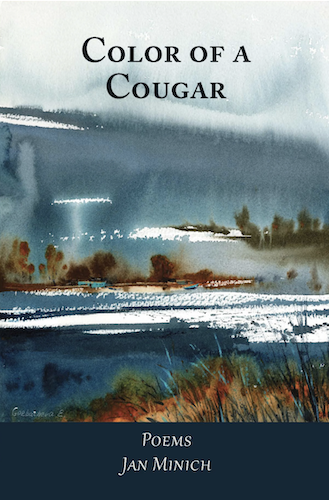
Color of a Cougar: Poems
by Jan Minich
47 Poems ~ 84 pages
Price: $25.00
Publisher: Broadstone Books
ISBN: 978-1-966677-50-5
To Order: Broadstone Books
Reviewed by Michael Escoubas
In his studied endorsement of Jan Minich’s poetry, poet Richard Hedderman states:
In Minich’s restorative vision, the natural world and the human community, the living and the dead, find solace and survival in the confirmation of the spirit.
Indeed, as I worked my way through Color of a Cougar, I became fascinated by Minich’s use of the basic visual elements of the world to reach the inner world of this reviewer. I began to see a unique interplay between nature and the infinite variations of light and shadow working together to express a wide range of human emotions. I noticed frequent references to darkness. I sensed a near preoccupation with darkness as a theme in Minich’s work. The interplay of light and dark, twilight and dawn, tragedy, and emergence, all framed by the poet’s firsthand experiences, signal life-affirmation as a major formative construct. Our review proposes to illustrate this structure.
Color of a Cougar is organized into four sections. The sections do not feature “Headings” that offer formal thematic cues. However, the sections tend to coalesce around the initial poems within each. Section I leads with, “Spreading Ashes in the Old Summers’ Burying Ground,“ and features the poet’s meditations about death. October, with its rich colorations and fragrances, its sounds of insects and frogs, frame the reality of both life and death according to seasons. This seasonal “gift” leads the poet, “so beautifully into winter …” Subsequent poems lend themselves to similar thought constructs. “The Storm,” has the poet perusing his mother’s dresser after her death. There, he muses over found objects: dog collars and leash buckles with notes attached recording their ages and dates when they died. He compares his own comfort in darkness with his mother’s. In a sense, the poet is “like” her, somehow, seeing better in the dark. Throughout the poem there is a palpable working out of light and dark, the noise of storms, the fear of storms. I needed to pause, from time to time, drop anchor and absorb their imaginative richness. In this section, I felt drawn to “Wild Again,” which sets forth one version of the poet’s perspective on death:
Loved ones are no longer with us
but they haven’t passed away.
They have merely died,
so much simpler
and more to their liking,
the relationship of an island
to its ponds and reclaimed lives
around the now wild strip-cuts.
“Flaming Gorge” opens Section II. These poems could easily be ekphrastic responses to art. This is not the case as Minich has dwelled a lifetime in waterways, lakes, and wilderness areas. The landscapes and waterscapes of his native Ohio, Wisconsin, and wilderness areas of Utah inform his poetry. Of the eight poems, all bear some reference to water and to sounds made by Nature’s inhabitants; noble creatures such as “antelope hooves / heading for sage slopes,” sunsets and sky colors that affect how one feels when alone with the firmament. None of this, however, is for its own sake. For Minich, images relate to human relationships that fall within Nature’s cycles. “Youth” provides a vivid, intimate picture of the natural world in persona:
Cottonwoods so old you feel
their age and alarm
at the drought
that doesn’t want to leave,
feel the love for their young
they hope will survive
after they have gone,
to feel the water again,
snowmelt and late summer rains
on the leaves and branches,
joy filtering into the sandy soil.
What is playing here? Both the poet and the forest “feel” something incredibly human. In this reviewer’s mind, Jan Minich is a rare talent in his ability to marry two worlds that become heart-accessible to readers. Out of the darkness that pervades his work, “joy” persistently seeps into life’s sandy soil.
Throughout the work, I felt that I was the poet’s sandy soil, and as such, he reached me … by the end, my spirit was nourished by an accomplished craftsman, whose poetry is certain to stand the test of time.
|


